保险知识:Commercial Property & CGL (Commercial General Liability)

根据 RIBO 考试的权重,这部分约占 15%–20%,也是很多人最容易混淆的章节。我会按照考试最喜欢考的顺序来讲。


第一部分 Commercial Property Review

先复习一下 Property 的核心。

1. Building vs Contents vs Stock

项目包括
Building建筑本身、固定设备(Fixtures)、Boilers、Electrical、Plumbing
Contents办公家具、电脑、机器、Equipment
Stock用来出售的商品、Raw materials、Finished goods、Packaging

RIBO最爱考

一家家具店:

Building
✔ 屋顶
✔ 墙
✔ 空调

Contents
✔ 收银机
✔ 办公桌
✔ Forklift

Stock
✔ 沙发
✔ 椅子
✔ 床

千万别把 Forklift 当成 Stock。


2. Replacement Cost vs ACV

Replacement Cost

赔新的

不用扣折旧

例如:

电脑价值
$5,000

旧了五年

今天买新的仍需
$5,000

Replacement Cost

$5,000


ACV

Actual Cash Value

Replacement Cost − Depreciation

例如:

新电脑
$5,000

折旧40%

$3,000


考试喜欢问

Which policy pays depreciation?

答案:

ACV


3. Co-insurance

这是 Commercial Property 最大重点。

公式必须会。Recovery=Insurance CarriedInsurance Required×LossRecovery=\frac{Insurance\ Carried}{Insurance\ Required}\times LossRecovery=Insurance RequiredInsurance Carried​×Loss

例如

Building Value

$1,000,000

80% Co-insurance

应该买

800,000

结果只买

400,000

损失

100,000

赔偿

400,000÷800,000×100,000

=

50,000


口诀:

买少了

赔比例

不是赔全部。


4. Earnings Form vs Profits Form

这是RIBO必考。

Earnings Form

Net Profit

Continuing Expenses


Profits Form

Gross Profit

比较简单。


考试通常问:

What is the basic difference?

答案:

Earnings Form includes continuing expenses.


5. Extra Expense

不是赔利润。

而是赔:

为了继续营业

额外花的钱。

例如:

租临时办公室

租机器

快递

加班

这些都属于

Extra Expense。


6. Equipment Breakdown

以前叫

Boiler & Machinery

赔:

Boiler

Pressure Vessel

Electrical

Mechanical

Air Conditioning

Generators

Transformers

Computer Controls


注意

它不是 Fire Policy。

它赔的是:

Equipment Breakdown

不是火灾。


第二部分 CGL

开始进入 Liability。

很多人觉得难。

其实就记住一句:

Commercial Property

赔自己的东西

CGL

赔别人。


什么是 CGL?

Commercial General Liability

赔:

企业因为疏忽

造成第三者

受伤

或财产损失。


例如

顾客滑倒

员工撞坏别人东西

广告侵权

产品伤人

这些都是

CGL。


CGL 三大核心 Coverage

考试一定考。

Coverage A

Bodily Injury

Property Damage

简称

BI/PD

例如

顾客滑倒

天花板掉下来

撞坏别人汽车

都是A。


Coverage B

Personal Injury

Advertising Injury

不是身体受伤。

包括:

Libel

Slander

False Arrest

Wrongful Eviction

Copyright

Advertising Injury


Coverage C

Medical Payments

特点:

不用证明责任。

No Fault。

例如:

顾客跌倒

公司先赔医疗费。

即使最后证明公司没责任。


考试最爱问

Which coverage does NOT require negligence?

答案

Coverage C

Medical Payments


Products & Completed Operations

RIBO 超爱考。

Products

产品卖出去以后。

例如:

卖电暖器

烧了别人房子。

Covered。


Completed Operations

工程已经完成。

例如:

水管修好了。

一个月后爆裂。

Covered。


如果

施工时

马上爆裂

属于:

Operations

不是

Completed Operations。


Occurrence

Occurrence

就是:

一次意外事故。

不是故意。

例如:

顾客滑倒。

就是Occurrence。


如果公司故意伤人

不赔。

Intentional Acts

Excluded。


Contractual Liability

通常:

合同责任

不赔。

但是:

Insured Contract

例外。

例如:

租赁合同

很多都会保。


Damage to Your Product

CGL

不会赔

自己的产品。

例如:

卖电视。

电视自己坏。

不赔。


但是:

电视爆炸

烧了客户家。

赔客户家。

不赔电视。


Damage to Your Work

自己做的工程

做坏了。

通常

不赔。

但是:

造成别人损失

赔别人。


例如

装修:

墙刷坏了。

重新刷。

不赔。

刷坏客户家具。

赔家具。


Care Custody Control (CCC)

RIBO 高频。

意思:

别人东西

在你保管期间。

通常

不赔。

例如:

修车厂。

客户车放你这里。

车烧了。

CGL

通常不赔。

需要:

Garage Policy。


Pollution

一般

Excluded。

除非:

Sudden

Accidental

Pollution。


Liquor Liability

酒吧

餐厅

需要单独考虑。

普通CGL

通常不足够。


记忆口诀(考试必背)

Commercial Property:

自己东西

CGL:

别人的人

别人的财产

Products:

卖出去以后

Completed Operations:

工程做完以后

Medical Payments:

No Fault


RIBO 真题风格练习(10题)

1. A customer slips on a wet floor in a retail store and fractures an arm. Which section of the CGL policy is most likely to respond?

A. Coverage A – Bodily Injury and Property Damage
B. Coverage B – Personal and Advertising Injury
C. Coverage C – Medical Payments only
D. Equipment Breakdown


2. A contractor finishes installing a water pipe. Two months later, it bursts and damages the client’s property. This loss falls under:

A. Products Liability
B. Completed Operations
C. Operations Liability
D. Property Insurance


3. A business sells a defective toaster. The toaster catches fire and damages the customer’s kitchen. What does the CGL typically cover?

A. Replacement of the toaster only
B. Damage to the kitchen only
C. Both the toaster and the kitchen
D. Neither the toaster nor the kitchen


4. Which Commercial Property coverage reimburses the extra costs incurred to keep a business operating after an insured loss?

A. Profits Form
B. Earnings Form
C. Extra Expense Coverage
D. Equipment Breakdown


5. Under a Commercial Property policy with an 80% co-insurance clause, what is the main consequence of carrying insufficient insurance?

A. The claim is automatically denied.
B. The deductible is waived.
C. The insured may receive only a proportional payment.
D. The insurer pays the full loss up to the policy limit.


6. Which type of property is classified as Stock?

A. Office desks used by employees
B. Computers used for administration
C. Finished goods held for sale
D. A forklift used in the warehouse


7. Which CGL coverage may pay medical expenses even if the insured is not legally liable?

A. Coverage A
B. Coverage B
C. Coverage C
D. Products Liability


8. Which of the following is generally excluded under a standard CGL policy?

A. Bodily injury to a customer caused by negligence
B. Property damage caused by a defective product after sale
C. Damage to the insured’s own defective product
D. Medical payments for a customer injured on the premises


9. A repair shop has a customer’s vehicle in its possession for servicing. The vehicle is damaged while in the shop’s care. Which statement is MOST accurate?

A. The standard CGL automatically covers the loss.
B. The loss is commonly excluded under the Care, Custody or Control exclusion.
C. Coverage applies under Medical Payments.
D. The Commercial Property policy automatically pays for the customer’s vehicle.


10. Which statement best describes Replacement Cost coverage?

A. It pays the replacement cost less depreciation.
B. It pays the market value of the property.
C. It pays the cost to replace damaged property with new property of like kind and quality, without deduction for depreciation (subject to policy conditions).
D. It always pays the original purchase price.


请先做完这 10 题(直接回复例如:1A 2B 3B…),我会像之前一样逐题讲解每一道题的陷阱,并总结这一章最容易失分的考点。

这一节是 CGL(Commercial General Liability)最重要的内容,RIBO 几乎每次考试都会出题。


一、什么是 Liability(责任)?

先不要看保险。

假设你去朋友家做客。

你不小心碰倒了电视。

电视摔坏了。

这时候:

是谁造成的?

你。

所以:

你要赔。

这就是 Liability(法律责任)。

保险公司只是帮你赔。


再举一个例子。

你开了一家奶茶店。

地板刚拖完。

员工忘记放:

⚠️ “Wet Floor”

一位顾客走进来。

滑倒。

骨折。

谁负责?

奶茶店。

为什么?

因为:

没有采取合理措施(Negligence)。

所以:

CGL 开始发挥作用。


二、CGL 到底赔什么?

记住一句话:

别人受伤

别人财产受损

因为你的疏忽

这就是 CGL。


三、CGL 分成三个 Coverage

很多教材直接写:

Coverage A

Coverage B

Coverage C

学生一下就懵了。

其实非常简单。


Coverage A(考试占比最高)

全名:

Bodily Injury & Property Damage Liability

简称:

BI/PD

它赔两件事。


第一件

Bodily Injury

身体受伤。

例如:

顾客滑倒。

员工把梯子放倒。

砸伤路人。

餐厅热咖啡烫伤顾客。

狗咬伤别人。

这些全部都是:

Bodily Injury。


来看几个例子。

例1

超市。

顾客踩到葡萄。

摔断腿。

赔什么?

医疗费

误工费

精神损失(法院判)

律师费

都是

Coverage A。


例2

餐厅。

服务员端热汤。

不小心洒到顾客身上。

顾客烫伤。

Coverage A。


所以:

只要有人:

受伤

先想到:

Coverage A。


第二件

Property Damage

赔别人财产。

例如:

装修公司。

施工时。

把客户的大理石地板砸坏。

赔谁?

客户。

Coverage A。


例如:

水管工。

修水管。

不小心把墙钻穿。

Coverage A。


例如:

搬家公司。

搬钢琴。

把客户电视撞坏。

Coverage A。


所以:

Coverage A

其实就是:

别人


身体

或者

财产

Coverage B

很多人最容易混。

它不是身体受伤。

它叫:

Personal Injury

Advertising Injury


什么叫 Personal Injury?

不是身体。

而是:

侵犯别人权利。

例如:

诽谤(Libel)

口头诽谤(Slander)

错误逮捕(False Arrest)

Wrongful Eviction

侵犯隐私


举例。

一家公司。

在网上说:

竞争对手卖假货。

后来法院认定:

是假的。

对方起诉。

属于:

Libel。

Coverage B。


例如:

保安。

把顾客误认为小偷。

锁起来。

后来发现抓错。

False Arrest。

Coverage B。


所以:

Coverage B

赔:

不是身体。

而是:

侵犯别人权利。


再说 Advertising Injury。

例如:

公司做广告。

偷用了别人照片。

被起诉。

Coverage B。


或者:

用了别人:

Logo

Copyright

广告内容。

被起诉。

Coverage B。


一句口诀:

Coverage B:

名誉、隐私、广告。


Coverage C

很多学生第一次学:

都会觉得奇怪。

为什么还要单独有 C?

因为:

Coverage C

叫:

Medical Payments。

它最大的特点:

不用证明谁有责任。

英文:

No Fault。


举个例子。

顾客走进商店。

踩空。

扭伤脚。

老板说:

“先去医院吧。”

保险公司:

先赔医疗费。

以后再调查:

到底是不是老板责任。


为什么这样设计?

因为:

医疗费比较少。

保险公司希望:

赶快解决。

避免顾客直接起诉。


所以:

Coverage C:

通常赔:

小额医疗费。

不用证明责任。


四、A 和 C 最大区别

这是考试最喜欢考。

举个例子。

顾客滑倒。

医疗费:

500元。

保险公司直接赔。

Coverage C。


如果:

顾客:

住院

骨折

一年不能工作

起诉

赔几十万。

Coverage A。


所以:

Coverage C:

小额医疗费。

No Fault。

Coverage A:

真正的法律责任。


可以记成这样:

Coverage A


法院赔偿

大金额

需要证明责任


Coverage C


医疗费

No Fault

金额较小

五、考试最喜欢出的陷阱

题目一

顾客在商店滑倒。

老板没有任何责任。

保险公司还能赔吗?

很多人选:

不能。

其实:

Medical Payments

可以赔。

答案:

Coverage C。


题目二

顾客起诉老板。

要求赔:

医疗费

误工费

精神赔偿

是哪一项?

Coverage A。


题目三

公司广告侵犯版权。

Coverage?

Coverage B。


题目四

老板说:

“竞争对手卖假货。”

后来证明:

假的。

Coverage?

Coverage B。


六、用一张图全部记住

Commercial General Liability(CGL)


─────────────────────────────────
│ │ │

Coverage A Coverage B Coverage C

身体受伤 名誉/广告 医疗费

别人财产 隐私权 No Fault

需要责任 不涉及身体 小额赔偿

七、RIBO 一定会考的一个案例

假设你经营一家餐厅,一天发生了四件事:

事件 1: 顾客踩到湿地板摔断腿,并起诉餐厅索赔医疗费、误工费和赔偿金。
➡️ Coverage A

事件 2: 顾客只是轻微扭伤脚,餐厅保险公司立即支付了急诊医疗费用,没有讨论责任。
➡️ Coverage C

事件 3: 餐厅在广告中盗用了另一家餐厅拍摄的照片,被起诉侵犯版权。
➡️ Coverage B

事件 4: 员工搬运货物时撞坏了隔壁商店的玻璃门。
➡️ Coverage A(Property Damage)


最后送你一个考试口诀(非常实用)

A = Accident(事故)

  • 身体受伤(Bodily Injury)
  • 财产损失(Property Damage)

B = Bad Words & Bad Ads(坏话和广告)

  • Libel(书面诽谤)
  • Slander(口头诽谤)
  • False Arrest
  • Copyright
  • Advertising Injury

C = Clinic(诊所)

  • Medical Payments
  • No Fault
  • 小额医疗费用

下一节我们讲 RIBO 最容易失分的内容:
Products Liability、Completed Operations、Care, Custody & Control(CCC)和 Contractual Liability。 这四个概念几乎每套真题都会出现,而且很多考生都会混淆。

Loading

保险知识:Homeowners Insurance

Homeowners Insurance(Habitational Insurance) 是 RIBO 考试的重点,占考试相当大的比例。根据 RIBO 的考试技能大纲,你需要熟悉以下内容:Coverage A–D、Named Perils vs Comprehensive、Exclusions、Liability、Condominium、Tenant、Seasonal Dwelling、Endorsements 等。

建议我们今天按 RIBO 真题思路来学。


今天学习计划(Day 1)

第一部分:Homeowners Policy 四大保障(必考★★★★★)

这是考试出现最多的知识。

Coverage保什么RIBO关键词
ADwelling Building房屋主体
BDetached Private Structures独立建筑
CPersonal Property个人财产
DAdditional Living Expenses (ALE)额外生活费用

Coverage A — Dwelling Building

保险的是:

✔ 房屋主体

包括:

  • 屋顶
  • 地基
  • 固定地板
  • 内置橱柜
  • 固定暖气系统
  • Plumbing
  • Electrical wiring

口诀:

Fixed to the house = Coverage A


RIBO喜欢问

下列哪些属于 Coverage A?

A. Sofa

B. Refrigerator built into kitchen

C. Bicycle

D. Television

答案:

✅ B

因为 Built-in appliance 属于房屋一部分。


Coverage B — Detached Private Structures

与房屋分开的建筑。

例如:

  • Detached garage
  • Shed
  • Gazebo
  • Fence
  • Greenhouse

但是:

必须与住宅有一定距离。

通常:

Detached Garage

Coverage B

Attached Garage

Coverage A


真题

Detached garage 被风吹倒。

属于?

A Coverage A

B Coverage B

C Coverage C

D Liability

答案:

✅ B


Coverage C — Personal Property

这是考试第二喜欢考的。

包括:

  • Furniture
  • Clothing
  • TV
  • Laptop
  • Jewelry
  • Bicycle
  • Toys
  • Dishes

一句话:

Everything you can take with you.


Off-premises

RIBO 很喜欢问:

Coverage C

不仅在家里赔

离开家

也赔

例如:

Laptop 在咖啡店被偷

仍可能获得赔偿(受保单条款限制)。


特殊限额(Special Limits)

考试经常问:

哪些东西有限额?

例如:

  • Jewelry
  • Cash
  • Coins
  • Furs
  • Firearms(知道有特殊限额即可)
  • Business Property

这些通常需要:

Scheduled Floater

增加保险。


Coverage D — Additional Living Expense (ALE)

这是最容易拿分的一章。

意思:

如果房子不能住,

保险公司支付:

✔ Hotel

✔ Restaurant

✔ Laundry

✔ Extra transportation

直到房子修好。


注意

赔的是:

Extra Cost

不是:

正常生活费用。

例如:

原来吃饭一天

$40

住酒店期间

一天

$90

保险赔:

$50

不是

$90


真题

房屋火灾后不能居住。

保险公司最可能支付:

A 房屋维修

B 酒店费用

C 新家具

D 汽车维修

答案:

✅ B


今天必须记住的一张图

HOMEOWNERS

Coverage A
House


Coverage B
Detached Garage
Fence
Shed


Coverage C
Personal Property


Coverage D
Additional Living Expenses
Hotel
Meals
Laundry

RIBO 高频陷阱

陷阱①

Attached Garage

→ Coverage A

Detached Garage

→ Coverage B


陷阱②

Built-in Dishwasher

→ Coverage A

Portable Dishwasher

→ Coverage C


陷阱③

Hotel

→ Coverage D


陷阱④

Jewelry

→ Coverage C

但有 Special Limit


小测验(5题)

1. Which coverage applies to a detached shed?

A. Coverage A

B. Coverage B

C. Coverage C

D. Coverage D


2. Which of the following is covered under Coverage C?

A. Roof

B. Fence

C. Sofa

D. Foundation


3. A built-in kitchen cabinet is insured under:

A. Coverage A

B. Coverage B

C. Coverage C

D. Coverage D


4. After a fire, the insured stays in a hotel for two weeks. Which coverage responds?

A. Coverage A

B. Coverage B

C. Coverage C

D. Coverage D


5. Which item is MOST likely subject to a special limit under Coverage C?

A. Dining table

B. Clothing

C. Jewelry

D. Bed


你先回答这 5 道题(例如:1B、2C、3A……)。

答完后,我带你进入 第二章:Named Perils vs Comprehensive Form(RIBO 最爱考的 Homeowners 章节),这一章几乎每套考试都会出现 4–6 道题。

第二章:Named Perils vs Comprehensive(★★★★★ RIBO 高频)

这是 Homeowners Insurance 最容易出陷阱题的部分。

记住一句话:

Named Perils = Only what is listed.
Comprehensive = Everything except what is excluded.


1. Named Perils(指定风险)

只有保单**明确列出的风险(Perils)**才赔。

例如保单列出:

  • Fire
  • Lightning
  • Windstorm
  • Hail
  • Explosion
  • Smoke
  • Theft

如果发生 Fire

✅ Covered

如果发生 Flood,但 Flood 没列:

❌ Not Covered

RIBO 思维

Is the peril named?

是 → Covered

不是 → No Coverage


2. Comprehensive(All Risks)

Comprehensive 的思维完全相反:

默认都赔,除非保单明确排除(Excluded)。

例如:

狗撞坏玻璃(不是故意)

虽然不是 Named Peril,

但如果没有 Exclusion,

✅ Covered。

所以考试常说:

Covered unless excluded.


3. RIBO 最喜欢考的区别

假设:

孩子踢足球把窗户踢碎。

在 Named Perils 下:

窗户被足球踢坏 不是 Named Peril

→ ❌ 不赔

在 Comprehensive 下:

不是 Exclusion

→ ✅ 赔


4. Dwelling 与 Personal Property 的保障形式(★★★★★)

很多考生会混淆。

在标准 Homeowners Broad Form 中:

  • Dwelling(Coverage A):Comprehensive(All Risks)
  • Personal Property(Coverage C):Named Perils

所以:

房子保障较广,

个人财产保障较窄。

考试陷阱

Homeowners Broad Form

Coverage A

All Risks

Coverage C

Named Perils

一定要记住。


5. Comprehensive 也有 Exclusions

不是所有东西都赔。

常见 Exclusions:

  • Wear and tear(自然磨损)
  • Rust(生锈)
  • Vermin(害虫)
  • Flood(通常不保)
  • Earthquake(通常不保,需要附加保障)
  • Intentional damage(故意损坏)

所以:

All Risks ≠ All Losses


RIBO 高频口诀

Named Perils

If it isn’t listed, it isn’t covered.

Comprehensive

If it isn’t excluded, it is covered.


高频陷阱

陷阱 1

Named Perils

Fire

Water escape(如果没列)


陷阱 2

Comprehensive

Unknown accidental damage

通常


陷阱 3

Wear and Tear

即使 Comprehensive

仍然

因为属于 Exclusion。


RIBO 真题风格练习(5题)

1. Under a Named Perils policy, which statement is correct?

A. All accidental losses are covered.

B. Only losses caused by listed perils are covered.

C. Everything is covered unless excluded.

D. Flood is always covered.


2. Which statement BEST describes Comprehensive coverage?

A. Only fire losses are covered.

B. Only named perils are covered.

C. All losses are covered, even if excluded.

D. Losses are covered unless specifically excluded.


3. A homeowner with Comprehensive coverage discovers damage caused by gradual wear and tear. Is it covered?

A. Yes, because Comprehensive covers all losses.

B. No, because wear and tear is normally excluded.

C. Yes, if the damage exceeds the deductible.

D. Only if caused by a fire.


4. Under a Broad Form homeowners policy, Coverage C (Personal Property) is generally insured on what basis?

A. Comprehensive

B. Replacement Cost only

C. Named Perils

D. Guaranteed Replacement Cost


5. A baseball accidentally breaks a window. The cause of loss is not listed in a Named Perils policy and is not excluded under a Comprehensive policy. Which statement is correct?

A. Covered under both policies.

B. Covered under Named Perils only.

C. Covered under Comprehensive only.

D. Not covered under either policy.


请直接回复答案,例如:

1B 2D 3B 4C 5C

如果你这 5 题也能全对,我们接下来学习 Broad Form、Comprehensive Form、Basic Form 三种 Homeowners 保单的区别——这是 RIBO Homeowners Insurance 中最核心、也最常考的内容。

RIBO 最容易混淆的四个词

问什么看什么典型答案
What perils are covered?Coverage BasisNamed Perils / Comprehensive
How much is paid?Loss SettlementReplacement Cost / ACV
What property is insured?Coverage A、B、C、DDwelling / Personal Property
What isn’t covered?ExclusionsFlood / Wear & Tear 等

📌 记住这张 RIBO 高频总结

Homeowners FormCoverage A(Dwelling)Coverage C(Personal Property)
Basic FormNamed PerilsNamed Perils
Broad FormComprehensive (All Risks)Named Perils
Comprehensive FormComprehensive (All Risks)Comprehensive (All Risks)

Broad Form = A 全险,C 指定风险,这是 RIBO 几乎每年都会考的知识点。

Basic Form(Named Perils Form)

Basic Form = 最基础、保障最少的 Homeowners 保单。

最大的特点:

Coverage A、B、C 都是 Named Perils(只保指定风险)。

也就是说:

Coverage保障方式
Coverage A(Dwelling)✅ Named Perils
Coverage B(Detached Structures)✅ Named Perils
Coverage C(Personal Property)✅ Named Perils
Coverage D(Additional Living Expenses)如果因**受保风险(insured peril)**导致房屋无法居住,则提供保障。

Basic Form 通常保障哪些 Named Perils?

RIBO 不要求死记每一个字,但下面这些属于高频:

✅ Fire(火灾)

✅ Lightning(雷击)

✅ Explosion(爆炸)

✅ Smoke(烟)

✅ Windstorm(暴风)

✅ Hail(冰雹)

✅ Riot(骚乱)

✅ Vandalism(故意破坏,通常有条件)

✅ Theft(盗窃,通常有条件)

✅ Aircraft(飞机)

✅ Vehicle Impact(车辆撞击)


不属于 Basic 自动保障的常见风险

这些通常需要附加保障(Endorsement)或单独购买:

❌ Flood(洪水)

❌ Earthquake(地震)

❌ Sewer Backup(污水倒灌,通常需附加保障)

❌ Overland Water(地表水,通常需附加保障)

❌ Wear and Tear(自然磨损)

❌ Rust(生锈)

❌ Rot(腐烂)

❌ Vermin(虫害、鼠害)


三种 Homeowners Form 一张图记住(★★★★★)

Homeowners FormCoverage ACoverage CRIBO 考试关键词
Basic FormNamed PerilsNamed Perils最基础保障
Broad FormComprehensiveNamed Perils最爱考
Comprehensive FormComprehensiveComprehensive保障最广

RIBO 最爱出的比较题

Basic Form

房顶被火烧毁。

✅ Covered

因为 Fire 是 Named Peril。


房顶因年久失修漏水。

❌ Not Covered

因为不是受保风险,而且属于维护问题。


孩子在家打球,不小心把电视砸坏。

❌ Not Covered

不是 Named Peril。


盗贼入屋偷走电视。

✅ Covered

Theft 是受保风险(受保单条款和条件限制)。


RIBO 考试口诀

Basic Form

Named Perils for both the building and personal property.

Broad Form

Comprehensive for the building, Named Perils for personal property.

Comprehensive Form

Comprehensive for both the building and personal property.


🎯 这里有一个容易混淆的地方(RIBO 很喜欢考)

不要把 Basic FormNamed Perils Form 当成两个不同的保单。

在 RIBO 的语境里,Basic Form 的特点就是采用 Named Perils 保障。考试通常不会要求你背所有受保风险,而更常考的是:

  • 哪一种 Homeowners Form 提供 Named Perils
  • 哪一种提供 Comprehensive
  • 哪一种保障范围最广?

掌握这三种 Form 的区别,比死记所有风险名称更重要。

这是 RIBO Homeowners Insurance 最重要的一章,几乎每次考试都会涉及 Basic、Broad、Comprehensive 三种 Form 的区别。


Broad Form(最常见的 Homeowners 保单)

Broad Form 可以理解成:

房屋保障升级了,但个人财产没有升级。

它最大的特点只有一句话:

Coverage保障方式
Coverage A(Dwelling)✅ Comprehensive (All Risks)
Coverage B(Detached Structures)✅ Comprehensive (All Risks,通常跟随 Dwelling)
Coverage C(Personal Property)✅ Named Perils
Coverage D(Additional Living Expenses)如果因受保风险导致无法居住,则赔偿额外生活费用。

考试口诀:

Broad = House Comprehensive + Contents Named Perils


Broad Form 比 Basic Form 多了什么?

假设发生一个意外但不是 Named Peril

例如:

孩子在家踢球,把窗户踢碎。

Basic Form

房屋(Coverage A)是 Named Perils。

足球不是 Named Peril。

❌ 不赔。


Broad Form

房屋(Coverage A)是 Comprehensive。

足球不是 Exclusion。

✅ 赔。


但是 Personal Property 仍然没有升级

例如:

你把自己的笔记本电脑摔到地上。

这是:

Coverage C(Personal Property)

Broad Form 下:

Coverage C = Named Perils。

“Accidentally dropped” 不是 Named Peril。

❌ 不赔。

这是 RIBO 最爱考的陷阱


Broad Form 仍然不保什么?

即使是 Comprehensive,也不是“什么都赔”。

常见 Exclusions:

  • ❌ Flood(洪水)
  • ❌ Earthquake(地震,通常需附加保障)
  • ❌ Sewer Backup(通常需附加保障)
  • ❌ Wear and Tear(自然磨损)
  • ❌ Rust(生锈)
  • ❌ Rot(腐烂)
  • ❌ Vermin(虫害、鼠害)
  • ❌ Intentional Damage(故意损坏)

记住:

Comprehensive = Covered unless excluded.

不是:

Everything is covered.


Basic vs Broad(RIBO 最爱比较)

项目Basic FormBroad Form
Coverage ANamed Perils✅ Comprehensive
Coverage BNamed Perils✅ Comprehensive(通常跟随 A)
Coverage CNamed PerilsNamed Perils
Coverage DALEALE
房屋保障基础更广
个人财产基础与 Basic 相同

RIBO 高频题

题目 1

树枝掉下来砸坏屋顶。

Broad Form 下:

Coverage A

Comprehensive

不是 Exclusion

✅ Covered


题目 2

手机从口袋滑落摔坏。

Broad Form 下:

Coverage C

Named Perils

不是 Named Peril

❌ Not Covered


题目 3(经典)

A homeowner has a Broad Form policy. A heavy object accidentally falls and damages the roof. The cause of loss is not a named peril and is not excluded.

赔吗?

✅ Yes

因为:

Coverage A = Comprehensive


⭐ RIBO 必背三句话

Basic Form

Building = Named Perils
Contents = Named Perils

Broad Form

Building = Comprehensive
Contents = Named Perils

Comprehensive Form

Building = Comprehensive
Contents = Comprehensive


🎯 我建议你这样记忆(考试最快)

Basic
A = NP
C = NP

Broad
A = Comp
C = NP

Comprehensive
A = Comp
C = Comp

Comprehensive Form(All Risks Form)

Comprehensive Form 是 Homeowners Insurance 中保障范围最广的标准保单。

它的核心只有一句话:

Building(房屋)和 Personal Property(个人财产)都采用 Comprehensive(All Risks)保障。


Coverage 方式

Coverage保障方式
Coverage A(Dwelling)✅ Comprehensive
Coverage B(Detached Structures)✅ Comprehensive(通常跟随 A)
Coverage C(Personal Property)✅ Comprehensive
Coverage D(Additional Living Expenses)因受保风险导致房屋不能居住时提供保障

与 Broad Form 的区别(★★★★★)

这是 RIBO 最喜欢考的地方。

FormCoverage ACoverage C
BasicNamed PerilsNamed Perils
BroadComprehensiveNamed Perils
ComprehensiveComprehensiveComprehensive

唯一的区别:

Broad Form:

Personal Property = Named Perils

Comprehensive Form:

Personal Property = Comprehensive


举例说明

例子 1:手机掉地上摔坏

手机属于:

Coverage C(Personal Property)

Basic Form

Named Perils

不是 Named Peril

❌ 不赔


Broad Form

还是 Named Perils

❌ 不赔


Comprehensive Form

Coverage C = Comprehensive

不是 Exclusion

✅ Covered(前提是没有其他适用的除外责任或限制)


例子 2:电视搬家时撞坏

电视属于:

Coverage C

Basic

Broad

Comprehensive


例子 3:屋顶被树砸坏

属于:

Coverage A

Basic

要看树倒下的原因是否属于 Named Peril。

Broad

Comprehensive


注意!

很多同学误以为:

Comprehensive = 什么都赔

这是错误的。

Comprehensive 的真正意思是:

Covered unless excluded.


常见 Exclusions

即使是 Comprehensive Form,

通常也不会赔:

❌ Wear and Tear(自然磨损)

❌ Rust(生锈)

❌ Rot(腐烂)

❌ Vermin(鼠害、虫害)

❌ Intentional Damage(故意损坏)

❌ Flood(洪水,通常需附加保障)

❌ Earthquake(地震,通常需附加保障)

RIBO 高频陷阱

题目

A homeowner accidentally drops a laptop while cleaning the house.

Which Homeowners Form is MOST likely to provide coverage?

A. Basic

B. Broad

C. Comprehensive

D. Tenant’s Form

答案:

✅ C

因为:

Laptop

Coverage C

只有 Comprehensive Form

Coverage C 是 Comprehensive。


三种 Form 一张图

CoverageBasicBroadComprehensive
A(House)NPCompComp
B(Detached Structures)NPCompComp
C(Contents)NPNPComp
D(ALE)

RIBO 30 秒记忆法(★★★★★)

Basic
House = NP
Contents = NP

Broad
House = Comp
Contents = NP

Comprehensive
House = Comp
Contents = Comp

🎯 RIBO 真题风格陷阱(试试看)

1. Which homeowners form provides Comprehensive coverage for both the dwelling and personal property?

A. Basic Form

B. Broad Form

C. Comprehensive Form

D. Tenant’s Form


2. Under a Broad Form policy, an insured accidentally drops a camera. The camera is damaged. Is it covered?

A. Yes

B. No


3. Under a Comprehensive Form policy, an insured accidentally drops the same camera. Is it covered?

A. Yes

B. No


4. Which homeowners form provides the widest protection?

A. Basic

B. Broad

C. Comprehensive

D. Named Perils


5.(RIBO 高频)

Which statement is TRUE?

A. Comprehensive Form covers every type of loss without exception.

B. Broad Form provides Comprehensive coverage for both the dwelling and personal property.

C. Comprehensive Form generally provides Comprehensive coverage for both the dwelling and personal property, subject to policy exclusions.

D. Basic Form provides Comprehensive coverage for the dwelling only.


⭐ 一个考试提醒

你目前已经学到的这部分,在真正的 RIBO 考试里,不会只考你背表格,更常见的是给一个具体事故,让你判断:

  1. 损坏的是哪一类财产?(Coverage A、B、C 或 D)
  2. 保单是哪一种 Form?(Basic、Broad、Comprehensive)
  3. 损失原因是 Named Peril、Comprehensive 可保风险,还是 Exclusion?

只要按这三个步骤分析,绝大多数 Homeowners Insurance 题目都能做出来。

Loading

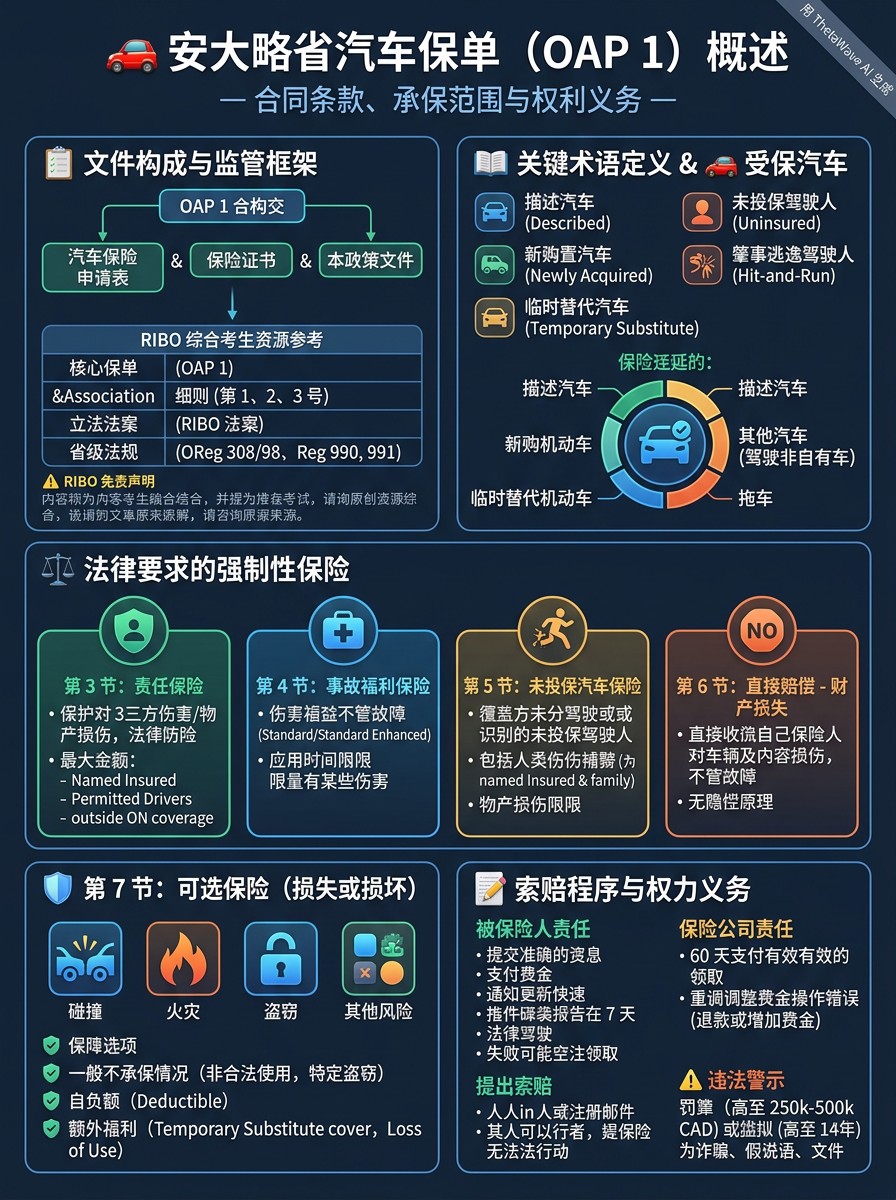
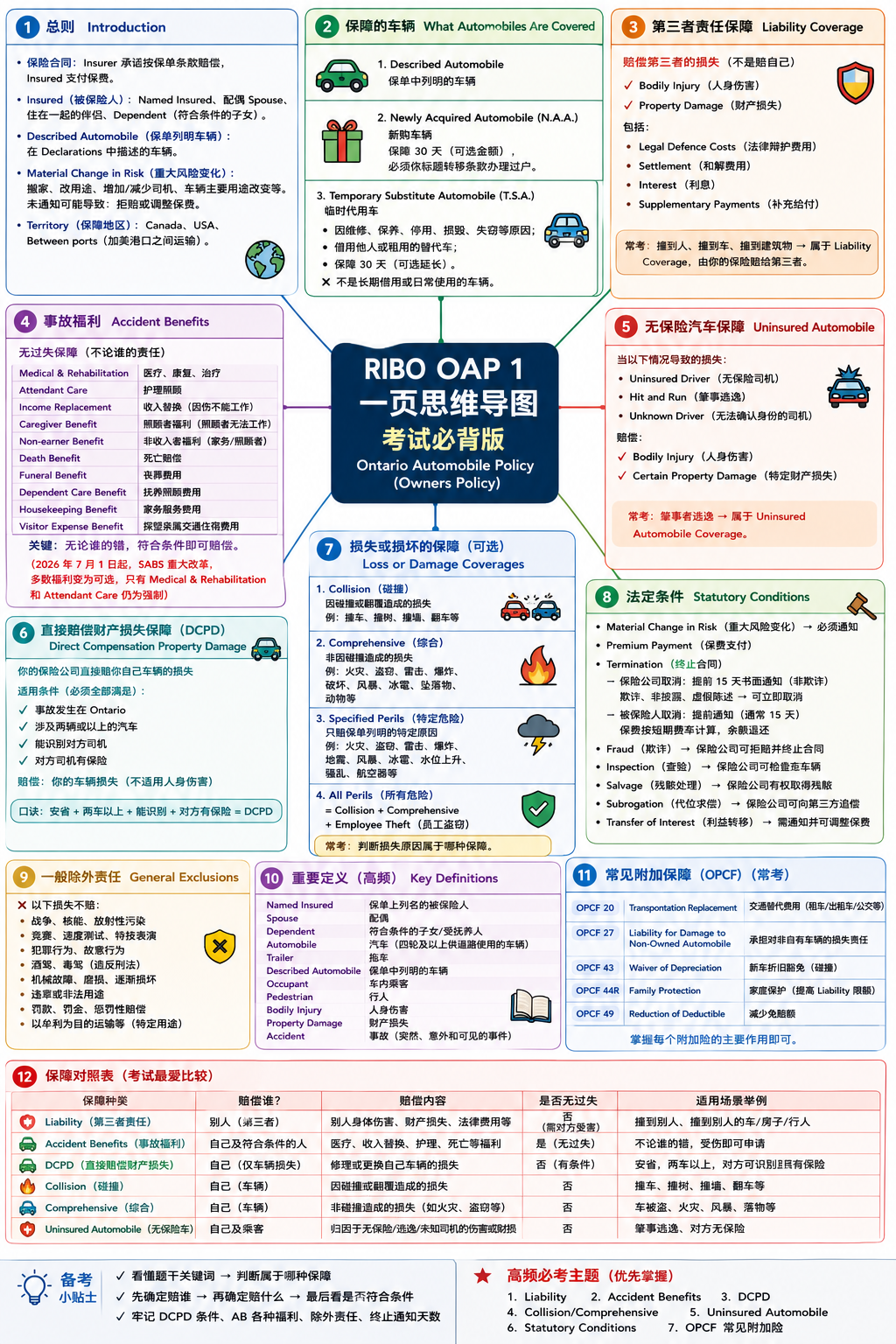
保险知识 :车保险 OAP1

如果你的目标是通过 RIBO Level 1,那么 Ontario Automobile Policy (OAP 1) 不需要逐字背诵,而是要掌握考试最常考的内容。自2024年开始,RIBO考试提供 OAP1 PDF 作为开卷资料,但真正考试时间很紧,不可能临场查阅,所以必须熟悉结构。


RIBO 必须掌握的 OAP 1 知识(★★★★★)

Section 1 – Introduction(总则)★★★★★

考试重点:

  • 什么是保险合同
  • Insured(被保险人)
  • Described Automobile(保单列明车辆)
  • Material Change in Risk(重大风险变化)
  • Territory(保障地区)
    • Canada
    • USA
    • Between ports(加拿大与美国港口之间运输)

常考:

如果搬家、改用途、增加司机,没有通知保险公司,会怎样?

答案:

Material Change → 保险公司可拒赔或调整保费。


Section 2 – What Automobiles Are Covered★★★★★

必须知道:

Covered Automobile 包括:

  • Described Automobile
  • Newly Acquired Automobile
  • Temporary Substitute Automobile

考试非常喜欢:

Temporary Substitute Automobile

例如:

你的车维修中

借朋友车

是否有保障?

答案:

✔ 有(满足条件)

但不是永久借车。


Section 3 – Liability Coverage★★★★★

这是最重要的一章。

必须会:

Third Party Liability

赔别人

不是赔自己。

包括:

✔ Bodily Injury

✔ Property Damage


考试喜欢问:

谁赔?

例如:

撞别人车

撞别人房子

撞到行人

都是:

Third Party Liability


还要知道:

Legal Defence Costs

Settlement

Interest

Supplementary Payments


Section 4 – Accident Benefits★★★★★

这是 RIBO 超高频。

必须知道:

Medical

Rehabilitation

Attendant Care

Income Replacement

Caregiver

Non-earner

Death Benefit

Funeral Benefit

Dependent Care

Housekeeping

Visitor Expenses

考试喜欢:

Which benefit applies?

例如:

不能工作

→ Income Replacement

需要照顾

→ Attendant Care

死亡

→ Death Benefit


注意:

自 2026 年 7 月 1 日起,安大略省事故福利(SABS)发生重大改革,许多原本强制的福利改为可选,仅医疗康复(Medical & Rehabilitation)和护理(Attendant Care)仍为强制保障。因此如果参加改革后的 RIBO 考试,需要特别留意新版规则。


Section 5 – Uninsured Automobile★★★★★

非常爱考。

包括:

Uninsured Driver

Hit and Run

Unknown Driver

赔什么?

自己的:

✔ Bodily Injury

✔ Certain Property Damage


考试:

Someone hits you and flees.

答案:

Uninsured Automobile Coverage


Section 6 – DCPD(★★★★★)

RIBO 最喜欢考之一。

Direct Compensation Property Damage

要牢记:

适用条件:

✔ Ontario

✔ Two or more automobiles

✔ Other driver identified

✔ Other driver insured

赔:

自己的车

不是别人赔你

而是:

自己的保险公司赔你。

考试几乎每年都有。


Section 7 – Loss or Damage Coverages★★★★★

一定会考。

四种:

Collision

撞车

撞树

撞墙

翻车


Comprehensive

不是碰撞造成。

例如:

Fire

Theft

Lightning

Explosion

Vandalism

Windstorm

Falling Object

Animal


Specified Perils

只有指定几项:

Fire

Theft

Lightning

Explosion

Earthquake

Windstorm

Hail

Rising Water

Riot

Aircraft


All Perils

=

  • Collision
  • Comprehensive
  • Employee Theft

考试最爱:

Which coverage pays?


Section 8 – Statutory Conditions★★★★★

超级重要。

尤其:

Material Change

Termination

Fraud

Inspection

Salvage

Subrogation


考试喜欢:

Insured commits fraud.

结果?

整个 claim 可被拒。


Termination

必须知道:

Insurer Cancellation

Insured Cancellation

Notice Days

Premium Refund


General Exclusions★★★★★

一定会考。

例如:

War

Nuclear

Racing

Criminal Acts

Intentional Damage

Wear and Tear

Mechanical Breakdown


OAP 1 常见 Definitions★★★★

要知道:

Named Insured

Spouse

Dependent

Automobile

Trailer

Described Automobile

Occupant

Pedestrian


Additional Benefits★★★★

例如:

Temporary Substitute Automobile

Newly Acquired Automobile

Transportation Replacement

Legal Costs


Combined Coverage★★★★★

考试喜欢比较:

Coverage赔谁
Liability别人
Accident Benefits自己
DCPD自己车
Collision自己车(碰撞)
Comprehensive自己车(非碰撞)
Uninsured无保险司机造成的损失

这是 RIBO 最容易考案例题的知识点。


OPCF(★★★★★)

考试一定考几题。

至少知道:

  • OPCF 20(Transportation Replacement)
  • OPCF 27(Liability for Damage to Non-Owned Automobile)
  • OPCF 43(Waiver of Depreciation)
  • OPCF 44R(Family Protection)
  • OPCF 49(Reduction of Deductible)

不用背全部条文,但要知道每个附加险的主要作用。


RIBO OAP1 高频考点(按重要程度)

⭐⭐⭐⭐⭐(必考)

  • Liability
  • Accident Benefits
  • DCPD
  • Collision vs Comprehensive
  • Uninsured Automobile
  • Statutory Conditions
  • Newly Acquired Auto
  • Temporary Substitute Auto
  • OPCF 常见附加险

⭐⭐⭐⭐

  • Definitions
  • Exclusions
  • Territory
  • Material Change in Risk
  • Cancellation

⭐⭐⭐

  • Supplementary Payments
  • Salvage
  • Inspection
  • Premium Adjustment

建议的复习顺序(效率最高)

如果你距离考试时间不多,建议按下面顺序学习:

  1. Liability(第三者责任)
  2. Accident Benefits(事故福利)
  3. DCPD
  4. Collision / Comprehensive / All Perils
  5. Uninsured Automobile
  6. Statutory Conditions
  7. OPCF 常见附加险
  8. Definitions & Exclusions

RIBO OAP 1 模拟测试(第一套)

第一部分:Liability(第三者责任)

1.

Tom accidentally runs a red light and hits another vehicle. The other driver suffers injuries and their vehicle is badly damaged.

Which coverage under Tom’s OAP 1 would respond?

A. Collision Coverage

B. Accident Benefits

C. Third Party Liability

D. Comprehensive Coverage


2.

After the accident above, Tom also suffers injuries himself.

Which section of his own policy pays for his medical expenses regardless of fault?

A. Collision

B. Accident Benefits

C. Third Party Liability

D. DCPD


第二部分:DCPD

3.

Sarah is stopped at a red light in Ontario when another identified Ontario driver rear-ends her.

Who pays for Sarah’s vehicle damage?

A. The at-fault driver’s insurer

B. Sarah’s own insurer under DCPD

C. Sarah herself

D. Accident Benefits


4.

Which ONE of the following is NOT required for DCPD to apply?

A. The accident occurs in Ontario.

B. Another vehicle is involved.

C. The other driver is identifiable.

D. You are injured in the accident.


第三部分:Collision vs Comprehensive

5.

A large tree falls onto Mike’s parked vehicle during a windstorm.

Which coverage would normally apply?

A. Collision

B. Comprehensive

C. DCPD

D. Liability


6.

Jenny backs into a concrete pole while parking.

Which coverage applies?

A. Comprehensive

B. Collision

C. Liability

D. Uninsured Automobile


第四部分:Temporary Substitute Automobile

7.

David’s insured vehicle is in the repair shop after an insured loss. He borrows his neighbour’s vehicle for three days.

Under OAP 1, the borrowed vehicle is most likely considered:

A. Newly Acquired Automobile

B. Temporary Substitute Automobile

C. Described Automobile

D. Uninsured Automobile


第五部分:Uninsured Automobile

8.

An uninsured driver runs a stop sign and crashes into Emma’s vehicle.

Which coverage may compensate Emma?

A. Comprehensive

B. Collision only

C. Uninsured Automobile Coverage

D. OPCF 43


9.

A hit-and-run driver damages your vehicle and cannot be identified.

Which coverage is MOST likely to respond?

A. Third Party Liability

B. Uninsured Automobile

C. Collision

D. DCPD


第六部分:Statutory Conditions

10.

An insured intentionally lies about how an accident occurred in order to obtain payment.

What is the likely consequence?

A. The insurer must still pay.

B. Only half of the claim is paid.

C. The insurer may deny the claim because of fraud.

D. Only the deductible increases.


11.

Which situation is considered a Material Change in Risk?

A. Washing the car every weekend.

B. Moving to another city without informing the insurer.

C. Filling the gas tank.

D. Rotating the tires.


第七部分:OPCF

12.

Which OPCF endorsement waives depreciation for a qualifying new vehicle?

A. OPCF 20

B. OPCF 27

C. OPCF 43

D. OPCF 44R


13.

Which OPCF provides Family Protection Coverage?

A. OPCF 44R

B. OPCF 20

C. OPCF 43

D. OPCF 27


第八部分:综合案例(考试最爱)

14.

Kevin is driving in Ontario when another identified driver runs a stop sign and hits his vehicle.

Kevin suffers a broken arm, and his car is damaged.

Which combination of coverages applies?

A. Liability + Collision

B. Accident Benefits + DCPD

C. Comprehensive + Liability

D. Collision + Uninsured Automobile


15.

Lisa accidentally backs into her own garage door, damaging both her vehicle and the garage.

Which coverage pays for the damage to Lisa’s own vehicle?

A. Liability

B. Comprehensive

C. Collision

D. Accident Benefits


难度升级(★★★★★)

16.

Which ONE of the following losses is covered under Comprehensive Coverage?

A. Collision with another vehicle

B. Theft of the automobile

C. Hitting a concrete barrier

D. Damage caused by careless parking


17.

An insured purchases a replacement vehicle.

What must the insured do to ensure it remains covered beyond the automatic coverage period?

A. Nothing.

B. Notify the insurer within the required period.

C. Buy OPCF 27.

D. Purchase Collision Coverage.


18.

Which coverage pays for damage you cause to another person’s vehicle?

A. Collision

B. DCPD

C. Third Party Liability

D. Comprehensive


19.

Which coverage is no-fault?

A. Liability

B. Accident Benefits

C. Collision

D. Comprehensive


20.

Which statement about DCPD is TRUE?

A. It pays for injuries.

B. It pays for damage to your own automobile when the required conditions are met.

C. It pays only when you are at fault.

D. It replaces Collision Coverage in every situation.


评分标准

  • 18–20 分:RIBO OAP 1 已掌握得很好。
  • 15–17 分:通过考试机会较高,再加强案例题即可。
  • 12–14 分:基础不错,但还需要巩固高频考点。
  • 11 分及以下:建议重点复习 Liability、Accident Benefits、DCPD、Collision vs Comprehensive

你还需要加强的知识点

建议重点复习以下两个口诀:

口诀一:Collision vs Comprehensive

Collision = Hit something(碰撞)

  • 撞车
  • 撞树
  • 撞墙
  • 撞柱子
  • 翻车

Comprehensive = Something hits you / 非碰撞

  • Fire
  • Theft
  • Hail
  • Wind
  • Falling object
  • Vandalism

口诀二:赔谁?

这是 RIBO 最爱考的概念。

Coverage赔谁?
Liability别人(Third Party)
Accident Benefits自己(医疗、收入等)
DCPD自己的车(符合条件时)
Collision自己的车(碰撞)
Comprehensive自己的车(非碰撞)
Uninsured Automobile自己(被无保险或肇事逃逸司机造成损失时

一个考试万能表(一定背)

情况Coverage
撞别人车Third Party Liability
自己车撞墙Collision
自己撞树Collision
自己翻车Collision
树倒砸车Comprehensive
火灾Comprehensive
偷车Comprehensive
冰雹Comprehensive
飞石(多数情况)Comprehensive
Hit & RunUninsured Automobile
自己受伤Accident Benefits
对方受伤Liability
自己车(符合 DCPD 条件)DCPD
撞鹿、撞熊、撞动物
Comprehensive

第 21 题

John accidentally hits a deer while driving.

Which coverage normally applies?

A. Collision

B. Comprehensive

C. Liability

D. DCPD


第 22 题

Your parked vehicle is stolen from a shopping mall.

A. Collision

B. Comprehensive

C. Liability

D. DCPD


第 23 题

You hit another driver’s vehicle and both vehicles are damaged.

Which coverage pays for the other driver’s vehicle?

A. Collision

B. Liability

C. DCPD

D. Comprehensive


第 24 题(经典陷阱)

Your vehicle slides on ice and hits a guardrail.

Which coverage pays for your vehicle?

A. Comprehensive

B. Collision

C. Liability

D. DCPD

很多人看到 ice(冰) 会误选 Comprehensive,但真正原因是车辆发生了碰撞,因此属于 Collision


第 25 题(RIBO 高频)

A rock falls from a cliff and lands on your parked automobile.

Which coverage applies?

A. Collision

B. Comprehensive

C. DCPD

D. Liability

RIBO 考试口诀(建议背下来)

Liability = Pay Others(赔别人)
Accident Benefits = Pay You(赔你的人)
Collision / Comprehensive / DCPD = Pay Your Vehicle(赔你的车)

RIBO OAP 1 真题风格模拟(20题)

1. Third Party Liability

David accidentally hits a cyclist. The cyclist is injured, and David’s own vehicle is also damaged.

Which coverage pays for the cyclist’s medical expenses?

A. Collision

B. Accident Benefits

C. Third Party Liability

D. DCPD


2. Accident Benefits

Maria is at fault in an automobile accident and suffers a broken leg.

Which statement is TRUE?

A. She cannot receive any benefits because she caused the accident.

B. Her medical expenses may be covered under Accident Benefits.

C. Her injuries are covered by Third Party Liability.

D. Her vehicle repairs are covered by Accident Benefits.


3. DCPD

Which situation qualifies for DCPD?

A. Your vehicle is stolen.

B. You strike a deer.

C. Another identified insured driver rear-ends you in Ontario.

D. You hit a parked vehicle.


4. Collision vs Comprehensive

Your parked automobile is damaged by hail.

Which coverage applies?

A. Collision

B. Comprehensive

C. Liability

D. DCPD


5. Collision

While avoiding a squirrel, you swerve and hit a telephone pole.

Which coverage pays for your vehicle?

A. Comprehensive

B. Collision

C. Liability

D. Uninsured Automobile

注意:不要被 “squirrel”(松鼠)误导。


6. Comprehensive

Which loss is MOST likely covered under Comprehensive?

A. Backing into a garage wall.

B. Collision with another vehicle.

C. Theft of the insured automobile.

D. Sliding into a guardrail.


7. Temporary Substitute Automobile

Your insured vehicle is being repaired after a covered loss. You borrow your sister’s car for two days.

The borrowed vehicle is MOST likely:

A. A newly acquired automobile.

B. A temporary substitute automobile.

C. An uninsured automobile.

D. Not covered.


8. Newly Acquired Automobile

After purchasing another vehicle, an insured should:

A. Wait until renewal to report it.

B. Notify the insurer within the required time.

C. Purchase OPCF 44R.

D. Cancel the original policy.


9. Material Change in Risk

Which situation is MOST likely a material change in risk?

A. Installing winter tires.

B. Moving to another city.

C. Washing the vehicle weekly.

D. Filling the gas tank.


10. Fraud

An insured intentionally exaggerates the value of stolen property.

What is the MOST likely consequence?

A. The insurer pays half.

B. Only the excess amount is denied.

C. The insurer may deny the claim because of fraud.

D. Nothing happens.


11. Uninsured Automobile

A hit-and-run driver cannot be identified.

Which coverage is MOST likely available?

A. DCPD

B. Liability

C. Uninsured Automobile

D. Collision


12. Liability

You accidentally damage your neighbour’s fence while reversing.

Which coverage responds?

A. Collision

B. Comprehensive

C. Third Party Liability

D. Accident Benefits


13. Accident Benefits

Which benefit is payable regardless of fault?

A. Collision

B. Income Replacement Benefit

C. Third Party Liability

D. Comprehensive


14. OPCF

Which endorsement waives depreciation on qualifying new vehicles?

A. OPCF 20

B. OPCF 27

C. OPCF 43

D. OPCF 44R


15. OPCF

Which endorsement increases protection if an at-fault driver has insufficient liability insurance?

A. OPCF 20

B. OPCF 27

C. OPCF 43

D. OPCF 44R


16. Comprehensive Trap

A large tree falls onto your parked automobile during a windstorm.

Which coverage applies?

A. Collision

B. Comprehensive

C. DCPD

D. Liability


17. Collision Trap

Your vehicle skids on ice and strikes another automobile.

Which coverage pays for your own vehicle (assuming you purchased it)?

A. Comprehensive

B. Collision

C. Liability

D. Accident Benefits


18. Liability vs Accident Benefits

You injure another driver and also injure yourself.

Which combination is correct?

A. Your injuries → Liability; Other driver’s injuries → Accident Benefits

B. Your injuries → Accident Benefits; Other driver’s injuries → Liability

C. Both injuries → Liability

D. Both injuries → Accident Benefits


19. Mixed Coverage

Another insured Ontario driver is 100% at fault and damages your vehicle.

Which coverage generally pays for your vehicle damage?

A. Collision

B. DCPD

C. Liability

D. Comprehensive


20. 综合案例(★★★★★)

Kevin is driving in Ontario. Another identified insured driver runs a red light and hits Kevin’s car.

Kevin suffers injuries, and his vehicle is damaged.

Which answer BEST describes the coverages?

A. Kevin’s injuries → Liability; Kevin’s vehicle → Collision

B. Kevin’s injuries → Accident Benefits; Kevin’s vehicle → DCPD

C. Kevin’s injuries → Comprehensive; Kevin’s vehicle → Liability

D. Kevin’s injuries → DCPD; Kevin’s vehicle → Accident Benefits


评分标准

  • 19–20 分:RIBO OAP 1 已达到优秀水平,案例题能力很强。
  • 17–18 分:通过考试把握较大,只需巩固少数易混点。
  • 15–16 分:基础扎实,但还要加强陷阱题训练。
  • 14 分及以下:建议重点复习 Liability、Accident Benefits、DCPD、Collision vs. Comprehensive

这套题的陷阱主要集中在:

  • Liability vs. Accident Benefits
  • Collision vs. Comprehensive(特别是动物、冰雪、坠落物)
  • DCPD 的适用条件
  • OPCF 高频附加险
  • Material Change、Fraud、Temporary Substitute Automobile

如果你能做到 18 分以上,以你目前的学习进度来看,OAP 1 这部分会非常有竞争力。

我建议你下一步

以你目前的程度,已经不太需要继续刷基础 OAP 1 题了。

更有价值的是进入 RIBO 真题综合案例训练,把汽车保险与其他保险知识结合起来。例如:

  • OAP 1 + 责任险
  • OAP 1 + 旅行保险
  • OAP 1 + 财产保险
  • OAP 1 + 商业保险

这种跨章节案例更接近正式考试的出题方式。

从这几天的练习来看,你在 OAP 1 部分已经达到可以把它作为“拿分模块”的水平。 接下来把精力放在商业险、财产险、旅行险等其他高频章节,会更有利于整体通过 RIBO 考试。

Loading

保险知识 – RIBO BY LAW ARTICLE 4

如果你正在学习 RIBO By-Law No. 3 – Article 4: Firm Classes of Registration,考试重点其实并不多,主要是记住三种 Firm Registration(公司注册类别)及其区别。
一、必须记住的三种 Firm Classes

Active Firm Licensee(活跃公司)

  • 可以向公众销售一般保险(General Insurance)。
  • 必须有一位 Level 3 Principal Broker。
  • 必须每年续牌。
  • 必须至少拥有 2 家安省持牌保险公司的 Letter of Intent 或 Brokerage Contract。
  • 可以雇佣 Level 1、2、3 Broker。�

考试关键词:

Sell insurance ✅
Principal Broker required ✅
Two insurer contracts ✅

Non-Active Firm Licensee(非活跃公司) 用途通常不是销售保险,而是:

Tax Corporation
Personal Service Corporation
Holding Company
Commission Corporation

特点:

  • 不能向公众销售保险。
  • 不能做广告。
  • 不能与客户签保险合同。
  • 可以接收佣金(符合规定时)。

考试关键词:

Cannot transact insurance
Cannot advertise
Commission only

Consultant Firm Licensee(顾问公司)

这种公司:
提供保险咨询服务。
不销售保险。
不收取保险佣金。
收取的是咨询费(Fee)。

考试关键词:
Advice only
No insurance sales
Fee for service

二、考试最喜欢考的比较

问题 Active Non-Active Consultant
可以卖保险? ✅ ❌ ❌
可以收保险佣金? ✅ 有条件可以 ❌
可以向公众宣传? ✅ ❌ 仅咨询业务
必须有 Principal Broker? ✅ ❌ ❌

三、常见考试题
Q1. Which firm class may transact insurance with the public?
✅ Active Firm Licensee
Q2. Which firm class is commonly used for a tax corporation?
✅ Non-Active Firm Licensee
Q3. A firm only provides insurance consulting and charges consulting fees. Which class is required?
✅ Consultant Firm Licensee

四、建议背诵口诀(很容易拿分)
Active = Sell Insurance(卖保险)
Non-Active = Hold Commission(持有公司/收佣金)
Consultant = Give Advice(做咨询)

RIBO Level 1 的法规(RIB Act、Regulations、By-Laws)大约占考试的四分之一,因此把 By-Law No. 3 学好可以稳定拿分。�

下面是我整理的 RIBO By-Law No. 3 考试重点(Articles 1–7):

RIBO By-Law No. 3 考试重点(Level 1)


⭐⭐⭐ Article 1 – Interpretation(定义)
考试指数:⭐⭐
主要认识一些术语即可:
Firm
Licensee
Principal Broker
Consultant
Active Firm
Non-Active Firm
通常不会考很深。

⭐⭐⭐⭐ Article 2 – Registration & Related Matters
考试指数:⭐⭐⭐⭐
一定要知道:
✅ 如何申请 License
✅ Renewal(续牌)
✅ Notification(哪些情况要通知 RIBO)
例如:
更改姓名
更改地址
更换雇主
被刑事起诉
破产
这些情况都必须按规定通知 RIBO。�

⭐⭐⭐⭐⭐ Article 3 – Individual Classes
考试指数:⭐⭐⭐⭐⭐(必考)
一定会考:
Level 1 Entry level 必须在 Principal Broker 监督下工作
Level 2 技术能力更高 , 仍需监督
Level 3 可以担任:
Principal Broker
Deputy Principal Broker
Supervising Broker

必须:
至少连续 24 个月 Level 1 或 Level 2 经验
通过 Level 3 Exam
在 Active Firm 工作。

⭐⭐⭐⭐⭐ Article 4 – Firm Classes
考试指数:⭐⭐⭐⭐⭐(必考)
只有三类:
类型 可以卖保险 是否有 Principal Broker
Active ✅ ✅
Non-Active ❌ ❌
Consultant ❌ ❌
口诀:
Active = Sell
Non-active = Hold
Consultant = Advise

⭐⭐⭐ Article 5 – Out of Province
考试指数:⭐⭐⭐
知道:
外省 Broker 若要在 Ontario 执业,需要符合 RIBO 要求,并取得相应注册。


⭐⭐⭐⭐⭐ Article 6 – Principal Broker
考试指数:⭐⭐⭐⭐⭐(高频)
一定要知道:

Principal Broker 的职责:

Supervise Brokers(监督经纪人)
Ensure Compliance(确保守法)
Training(培训员工)
Maintain Professional Standards(维持专业标准)

很多题目会问:
Who is responsible?
答案通常都是:
✅ Principal Broker

⭐⭐⭐⭐ Article 7 – Continuing Education(CE)
考试指数:⭐⭐⭐⭐
知道:
所有持牌 Broker 都必须完成 Continuing Education(继续教育),Principal Broker 等管理职位还有额外要求。

最容易考的 10 个知识点

Active Firm 可以卖保险。
Non-Active Firm 不能卖保险。
Consultant 只能提供咨询。
Level 1 必须接受监督。
Level 3 才能担任 Principal Broker。
Principal Broker 负责监督 Broker。
更换雇主需要通知 RIBO。
更改姓名、地址等重要信息需要通知 RIBO。
所有持牌人需要完成 Continuing Education。
Active Firm 必须指定一名符合资格的 Principal Broker。

考前复习建议

如果你的目标是 RIBO Level 1 一次通过,建议按下面的优先级复习:
第一优先: Article 3、4、6
第二优先: Article 2、7
第三优先: Article 1、5

这样能覆盖 By-Law No. 3 中绝大多数常见考点。接下来如果你愿意,我还可以帮你整理 RIB Act + Ontario Regulation 991 的高频考点,以及 ⁠50 道最接近正式考试风格的 RIBO Level 1 模拟题,帮助你考前冲刺。

当然可以,我可以帮你做一套50道高仿RIBO Level 1模拟题(原创,不是复制真实考题),题型和正式考试一样,以情景题(Scenario-based)为主,因为目前 Level 1 考试越来越强调实际应用,而不是死记硬背。�

由于一次回复放不下 50 题,我们分 5 套,每套 10 题。我会在每套后面附答案和解析。


RIBO Level 1 Mock Exam(Set 1)


Question 1
A broker has recently moved to a new home. What must the broker do?
A. Notify the insurance company only
B. Notify RIBO of the address change
C. Notify clients only
D. No action is required

Question 2
Which class of firm may legally sell general insurance to the public?
A. Consultant Firm
B. Non-Active Firm
C. Active Firm
D. Holding Company

Question 3
A Level 1 broker wishes to bind coverage for a commercial client without consulting anyone.
What is TRUE?
A. This is always permitted.
B. A Level 1 broker must work under appropriate supervision.
C. Only Level 2 brokers require supervision.
D. The broker may act independently after six months.

Question 4
Which individual is responsible for ensuring a brokerage complies with RIBO requirements?
A. Receptionist
B. Claims Adjuster
C. Principal Broker
D. Insurance Company Underwriter

Question 5
A brokerage wants to establish a corporation solely to receive commission income and does not intend to transact insurance.
Which registration class is appropriate?
A. Active Firm
B. Consultant Firm
C. Non-Active Firm
D. Level 3 Firm

Question 6
Which of the following is an example of a moral hazard?
A. A building with faulty wiring.
B. A driver intentionally exaggerates a claim.
C. A home located beside a river.
D. Ice on a sidewalk.

Question 7
An applicant has submitted several large claims over the past three years.
An underwriter is MOST likely evaluating:
A. Risk history
B. Deductible amount
C. Policy wording
D. Coinsurance

Question 8
After paying a loss to its insured, an insurer seeks recovery from the negligent third party.
This legal right is called:
A. Indemnity
B. Contribution
C. Subrogation
D. Salvage

Question 9
Which insurance principle prevents an insured from profiting from a loss?
A. Utmost Good Faith
B. Insurable Interest
C. Indemnity
D. Proximate Cause
Question 10
A brokerage provides insurance advice only and charges consulting fees.
Which class of registration best describes this business?
A. Active Firm
B. Consultant Firm
C. Non-Active Firm
D. Level 3 Brokerage
答案
B
C
B
C
C
B
A
C
C
B
难度分析(★★★★★)
Q1:★☆☆☆☆(送分题)
Q2:★★☆☆☆
Q3:★★★☆☆
Q4:★★☆☆☆
Q5:★★★☆☆
Q6:★★★☆☆
Q7:★★★☆☆
Q8:★★★★☆(高频)
Q9:★★★★☆
Q10:★★☆☆☆
这套题主要覆盖了 RIBO By-Law、RIB Act、保险基本原则(Principles of Insurance)和 Underwriting,与正式考试常见题型一致。�

接下来�⁠我可以继续为你出 Set 2(第11–20题)

难度会更接近正式考试,增加更多汽车保险(OAP 1)、Homeowners、Travel Health 和 Commercial Insurance的综合情景题。

很好,Set 2 我会提高一点难度,更接近 RIBO Level 1 正式考试的情景题(Scenario-based)。正式考试很多题目都会先给一个客户场景,再问你最合适的处理方式,而不是单纯考定义。

RIBO Level 1 Mock Exam – Set 2(Questions 11–20)

Question 11
A client calls to add a newly purchased vehicle to an existing auto policy. Before confirming coverage, the broker should FIRST:
A. Issue a pink card immediately
B. Obtain the necessary underwriting information
C. Tell the client to contact the claims department
D. Wait until the renewal date


Question 12
A homeowner intentionally sets fire to their own house to collect insurance money.This violates the principle of:
A. Insurable Interest
B. Utmost Good Faith
C. Indemnity
D. Proximate Cause

Question 13
A Level 1 broker is unsure how to handle a commercial insurance request.
What should the broker do?
A. Guess the answer and proceed
B. Decline the client immediately
C. Consult the supervising broker or Principal Broker
D. Bind the coverage first and ask later
Question 14
Which of the following is a physical hazard?
A. A dishonest insured
B. A driver who exaggerates claims
C. Worn-out electrical wiring in a building
D. Poor financial history

Question 15
Which statement about insurable interest is TRUE?
A. A person may insure any stranger’s property.
B. An insured must suffer a financial loss if the property is damaged.
C. Insurable interest is required only for automobile insurance.
D. Insurable interest applies only after a loss occurs.
Question 16
An insurer refuses to insure an applicant because of multiple at-fault accidents and numerous traffic convictions.
This is primarily an:
A. Accounting decision
B. Underwriting decision
C. Claims decision
D. Marketing decision
Question 17
A brokerage discovers that one of its brokers has been giving incorrect insurance advice to clients.
Who has the primary responsibility to address this issue?
A. The client
B. The insurance company
C. The Principal Broker
D. The receptionist
Question 18
Which of the following best describes the principle of Utmost Good Faith?
A. Both insurer and insured must disclose all material facts.
B. Only the insurer must act honestly.
C. Only the insured must disclose losses after a claim.
D. Neither party has a duty to disclose information.
Question 19
A client reports a loss immediately after a windstorm damages their roof.
The broker should FIRST:
A. Promise the claim will be paid.
B. Assist the client in reporting the claim and explain the claims process.
C. Tell the client to repair everything without documentation.
D. Guarantee the settlement amount.
Question 20
Which of the following people may legally act as a Principal Broker?
A. Any Level 1 broker
B. Any Level 2 broker
C. A qualified Level 3 broker
D. Any licensed insurance agent
答案
B
B
C
C
B
B
C
A
B
C
考点解析(重点)
Q11
关键词:Underwriting Information(核保资料)
不要急着承诺保障,先确认车辆、驾驶员、用途等资料,再决定如何处理。
Q12
关键词:Utmost Good Faith(最大诚信原则)
故意纵火骗赔属于欺诈,违反诚信原则,是考试高频考点。
Q14
牢记三类风险因素:
Physical Hazard(物理危险):如老化电线、湿滑地面。
Moral Hazard(道德危险):如故意骗保、纵火。
Morale Hazard(心理/态度危险):如因有保险而变得粗心大意。
Q18
Utmost Good Faith = 双方都要披露重大事实(Material Facts)。
例如,客户隐瞒重大驾驶记录或保险公司隐瞒重要条款,都可能影响保险合同。
Q19
Broker 不能保证赔偿结果,只能协助客户报案、解释理赔流程,并由保险公司调查决定是否赔付。
本套涉及的考试模块
✅ Underwriting(核保)
✅ Principles of Insurance(保险基本原则)
✅ Level 1 Broker Responsibilities(一级经纪人职责)
✅ Principal Broker Responsibilities(首席经纪人职责)
✅ Claims Handling(理赔流程)
✅ Hazard Types(风险类型)
建议练习方法:做题时不要只记答案,更要学会识别题目中的“关键词”,例如:
supervision → Level 1 / Principal Broker
material fact → Utmost Good Faith
financial loss → Insurable Interest
recover from third party → Subrogation
no profit from loss → Indemnity
掌握这些关键词,在正式考试中会更容易快速定位正确答案。

很好,下面进入 RIBO Level 1 Mock Exam – Set 3(第21–30题)。

这一套难度进一步提高,更接近正式考试,包含情景分析和“最佳答案(BEST answer)”题型。正式考试中,很多题都有两个看似正确的选项,你需要选最符合 RIBO 规范的那个。
RIBO Level 1 Mock Exam – Set 3(Questions 21–30)

Question 21
A client asks a broker to backdate an automobile policy because an accident occurred yesterday and the client had forgotten to purchase insurance.
What should the broker do?
A. Backdate the policy to help the client.
B. Refuse because insurance cannot be backdated to cover a known loss.
C. Issue the policy and report it later.
D. Ask the insurance company after issuing the policy.

Question 22
Which of the following is considered a material fact that must be disclosed to the insurer?
A. The insured’s favorite colour
B. A previous cancellation for non-payment of premium
C. The insured’s favorite sports team
D. The broker’s commission

Question 23
A broker receives a premium cheque from a client.
The broker should:
A. Deposit it into the brokerage’s trust account according to brokerage procedures.
B. Deposit it into a personal bank account temporarily.
C. Hold it until renewal.
D. Cash it and pay the insurer later if convenient.

Question 24
A customer asks, “Why is my premium higher than my neighbour’s?”
The BEST answer is:
A. Premiums are determined using underwriting factors unique to each risk.
B. The insurer charges random premiums.
C. The broker decides every premium.
D. Premiums are always based only on age.

Question 25
Which of the following is NOT one of the four essential elements of a legally binding insurance contract?
A. Offer and Acceptance
B. Consideration
C. Legal Capacity
D. Profit


Question 26
A client deliberately states that they drive only 5,000 km per year when they actually drive 30,000 km.
This is an example of:
A. Material Misrepresentation
B. Physical Hazard
C. Contribution
D. Salvage

Question 27
Which policy is MOST likely to provide liability coverage if a visitor slips on an icy walkway at the insured’s home?
A. Automobile Policy
B. Homeowners Policy
C. Travel Insurance
D. Marine Policy

Question 28
A broker is unable to answer a client’s technical insurance question.
The broker should:
A. Invent an answer.
B. Tell the client not to worry.
C. Seek assistance from a qualified person before giving advice.
D. Ignore the question.
Question 29
Which principle requires that more than one insurer sharing the same loss pays only its fair proportion?
A. Subrogation
B. Contribution
C. Indemnity
D. Proximate Cause
Question 30
A brokerage wishes to advertise insurance products to the public.
Which class of firm is permitted to do so?
A. Consultant Firm
B. Non-Active Firm
C. Active Firm
D. Commission Corporation
答案
B
B
A
A
D
A
B
C
B
C
重点解析(正式考试高频)
Q21 — 已知损失(Known Loss)
保险的基本原则之一是不能为已经发生且已知的损失投保。因此,不能倒签(backdate)保单。
Q22 — Material Fact(重大事实)
任何可能影响保险公司决定是否承保、如何定价或附加条件的信息,都属于重大事实。例如:
以往拒保或取消保单
驾驶记录
理赔记录
房屋用途变化
Q23 — Premium Handling(保费处理)
客户保费必须按照经纪公司的程序处理,通常涉及信托账户(Trust Account)。绝不能存入个人账户。
Q25 — 合同四大要素
保险合同成立通常需要:
Offer and Acceptance(要约与承诺)
Consideration(对价)
Legal Capacity(缔约能力)
Legal Purpose(合法目的)
Profit(获利)不是合同成立要件,因此是正确答案。
Q29 — Contribution vs. Subrogation
这是考试最容易混淆的一组概念:
Contribution(分摊):多个保险人共同承担同一损失。
Subrogation(代位求偿):保险公司赔偿后向责任第三方追偿。
记忆技巧:
Contribution = Company ↔ Company
Subrogation = Company → Third Party
本套重点覆盖
✅ Material Facts(重大事实)
✅ Misrepresentation(虚假陈述)
✅ Trust Account(信托账户)
✅ Insurance Contract(保险合同)
✅ Liability Coverage(责任保险)
✅ Contribution 与 Subrogation
✅ Active Firm 权限
考试提示:RIBO Level 1 很少考纯定义,更喜欢问“作为一名经纪人,下一步最合适的做法是什么(What should the broker do FIRST/BEST?)”。做题时优先考虑是否符合法律、职业道德和 RIBO 的监管要求。

�⁠下一套 Set 4(31–40题) 我会加入更多 Ontario Auto(OAP 1)Property InsuranceCommercial Insurance 的综合情景题,难度将更接近正式考试。

非常好!Set 4 的难度已经接近正式 RIBO Level 1 考试。这套题重点考 Ontario Auto (OAP 1)、Property Insurance、Commercial Insurance,并结合经纪人的实际工作情景。

RIBO Level 1 Mock Exam – Set 4 (Questions 31–40)


Question 31
A client purchases a new vehicle on Saturday evening. The brokerage is closed until Monday, but the client wants to drive the vehicle immediately.
What is the BEST advice?
A. Drive the vehicle without insurance until Monday.
B. Wait until insurance coverage has been properly arranged before driving.
C. Drive only during daylight hours.
D. Use the previous owner’s insurance.

Question 32
A homeowner starts operating a bakery from the basement without informing the insurer.Why is this important?
A. It may be a material change in risk that should be reported.
B. Home insurance automatically covers every business.
C. It affects only the municipal property tax.
D. It has no effect on insurance.

Question 33
A commercial client wants insurance for a warehouse storing flammable chemicals.
Which underwriting factor is MOST important?
A. The owner’s favourite sport.
B. The fire hazard associated with the business.
C. The broker’s years of experience.
D. The colour of the warehouse.

Question 34
A client has both a homeowners policy and a separate policy covering the same valuable jewelry.
If both policies cover the loss, which insurance principle applies?
A. Subrogation
B. Contribution
C. Salvage
D. Proximate Cause
Question 35
A client asks whether increasing the deductible will usually affect the premium.
The BEST response is:
A. Higher deductibles often reduce premiums.
B. Higher deductibles always increase premiums.
C. Deductibles have no effect on premiums.
D. Deductibles apply only to liability claims.
Question 36
An Ontario driver allows their automobile insurance policy to lapse for two months.
Which statement is MOST accurate?
A. There are no consequences.
B. The insurer may consider the lapse during future underwriting.
C. The driver’s licence is automatically cancelled.
D. Future premiums must remain unchanged.
Question 37
A restaurant owner asks for insurance covering damage to customers if they are injured on the premises.
Which coverage is MOST appropriate?
A. Commercial General Liability (CGL)
B. Collision Coverage
C. Accident Benefits
D. Comprehensive Automobile Coverage

Question 38
A severe windstorm damages both a client’s garage and fence.
The broker should FIRST:
A. Guarantee payment.
B. Explain the claims process and advise the client to document the damage.
C. Tell the client repairs are never covered.
D. Promise the insurer will pay the full replacement cost.

Question 39
A Level 1 broker receives a request to insure a large manufacturing plant but has little experience with commercial risks.
What should the broker do?
A. Handle the file alone.
B. Seek guidance from an experienced broker or Principal Broker.
C. Decline every commercial risk.
D. Estimate the coverage without reviewing the exposures.

Question 40
Which statement best describes the role of underwriting?
A. To guarantee every applicant receives insurance.
B. To evaluate risk and determine whether and on what terms insurance should be offered.
C. To settle claims after a loss.
D. To investigate criminal offences.
Answer Key
B
A
B
B
A
B
A
B
B
B
考试重点解析
Q31(Ontario Auto)
记住:没有保险,不能开车。
正式考试经常考 “What should the broker advise?”,答案通常是遵守法律,不提供可能违法的建议。
Q32(Property Insurance)
Home Insurance 是按住宅用途(Residential Use)承保的。
如果:
开餐馆
美容院
Daycare
网店仓库
地下室烘焙坊
都可能属于 Material Change in Risk(重大风险变化),必须通知保险公司。
Q33(Commercial Insurance)
商业保险最重要的是识别 Exposure(风险暴露)。
例如:
Warehouse(仓库)
Restaurant(餐厅)
Auto Repair Shop(修车厂)
Chemical Storage(化学品仓储)
都会重点评估火灾、责任和财产风险。
Q34(Contribution)
如果两份保单同时承保同一损失:
Home Policy
Scheduled Jewelry Policy
通常由两家保险公司按规定分担赔偿责任,而不是双倍赔付。
Q35(Deductible)
RIBO 高频知识点:
Higher Deductible → Lower Premium(通常)
Lower Deductible → Higher Premium(通常)
Q37(Commercial General Liability)
考试中看到:
Customer injured
Slip and fall
Restaurant
Retail Store
Office
第一反应应想到 Commercial General Liability (CGL)。
Q40(Underwriting)
核保员(Underwriter)的主要职责包括:
是否承保(Accept/Decline)
保费(Premium)
免赔额(Deductible)
承保条件(Terms & Conditions)
不负责理赔决定。
本套覆盖的考试模块
✅ Ontario Auto (OAP 1)
✅ Property Insurance
✅ Homeowners Insurance
✅ Commercial Property
✅ Commercial General Liability (CGL)
✅ Deductibles
✅ Underwriting
✅ Material Change in Risk
✅ Claims Handling
考前提醒
从近年的考试趋势来看,这类综合情景题越来越多,关键不是死记定义,而是判断经纪人在当下情境中最合规、最专业的下一步行动。做题时遇到 BEST、FIRST、MOST appropriate 等词,要优先选择符合 RIBO 法规、职业责任和客户利益的答案,而不是仅仅“看起来可行”的做法。

当然!下面是最后一套 RIBO Level 1 Mock Exam – Set 5(Questions 41–50)。这一套是我按照 RIBO 官方考试蓝图的风格设计的,难度约 ★★★★☆(接近正式考试),很多题目都属于正式考试常见的 “BEST Answer” 类型。

RIBO Level 1 Mock Exam – Set 5 (Questions 41–50)


Question 41
A client tells a broker that they occasionally use their personal vehicle to deliver food for a mobile app.
What should the broker do?
A. Ignore the information.
B. Advise the client to disclose this use to the insurer because it may affect coverage.
C. Tell the client not to mention it.
D. Automatically cancel the policy.
Question 42
Which of the following is the BEST example of morale hazard?
A. A driver becomes less careful because they have insurance.
B. A building has faulty wiring.
C. An insured intentionally sets fire to a building.
D. A roof is damaged by hail.
Question 43
A broker discovers that an application contains incorrect information before it is submitted.
What should the broker do?
A. Submit it anyway.
B. Correct the information before submitting it.
C. Let the insurer discover the error.
D. Ask the client to sign it unchanged.
Question 44
A client asks, “Can you guarantee my claim will be approved?”
The BEST response is:
A. Yes.
B. No. The insurer determines coverage after reviewing the facts and policy.
C. Yes, if the loss is expensive.
D. Yes, because the broker decides claims.
Question 45
Which of the following would MOST likely require a commercial insurance policy instead of a personal homeowners policy?
A. A family living in their own house.
B. A retail clothing store.
C. A condominium owner.
D. A tenant renting an apartment.
Question 46
An insurer pays its insured for damage caused by a negligent contractor.
The insurer then sues the contractor.
This is an example of:
A. Contribution
B. Subrogation
C. Salvage
D. Indemnity
Question 47
A client asks for the minimum mandatory automobile coverage required to legally drive in Ontario.
Which coverage is required?
A. Third-Party Liability.
B. Collision Coverage.
C. Comprehensive Coverage.
D. Rental Vehicle Coverage.
Question 48
A Level 1 broker receives a question they cannot answer before the policy is issued.
The BEST action is:
A. Guess based on previous experience.
B. Delay the answer indefinitely.
C. Obtain assistance from a qualified broker or underwriter before advising the client.
D. Tell the client coverage definitely exists.
Question 49
A brokerage receives a complaint from a customer about poor service.
Who is primarily responsible for ensuring the brokerage has procedures to deal with complaints?
A. Every client.
B. The Principal Broker.
C. The receptionist.
D. The insurance adjuster.
Question 50
What is the PRIMARY purpose of insurance?
A. To allow people to profit from losses.
B. To transfer financial risk from the insured to the insurer, subject to the policy terms.
C. To eliminate every possible risk.
D. To guarantee that every claim will be paid.
Answer Key
Q
Answer
41 B
42 A
43 B
44 B
45 B
46 B
47 A
48 C
49 B
50 B
⭐ 最后冲刺:RIBO Level 1 必背 20 个高频考点
如果你只能在考前花 30 分钟复习,建议重点记住以下内容:
Level 1 Broker 必须在适当监督下工作。
Principal Broker 负责监督经纪人并确保经纪公司遵守 RIBO 要求。
Active Firm 可以销售保险;Non-Active Firm 不可以。
Material Facts(重大事实)必须如实披露。
Utmost Good Faith(最大诚信)要求双方诚实披露重大事实。
Indemnity:赔偿损失,不允许从损失中获利。
Subrogation:保险公司赔付后向责任第三方追偿。
Contribution:多家保险公司共同分摊同一损失。
Physical Hazard:如老旧电线、湿滑地面。
Moral Hazard:故意骗保、纵火等欺诈行为。
Morale Hazard:因有保险而变得疏忽大意。
Underwriter 决定是否承保及承保条件。
经纪人不能保证理赔一定获批。
经纪人不能倒签保单来覆盖已知损失。
重大风险变化(Material Change in Risk)应及时通知保险公司。
Ontario 法律要求车辆至少有第三者责任保险(Third-Party Liability)等法定保障才能合法上路;碰撞险不是强制购买。
Higher Deductible 通常意味着 Lower Premium。
Commercial General Liability (CGL) 主要保障企业因经营活动对第三者造成的人身伤害或财产损失的责任。
经纪人遇到不确定的问题,应向主管或核保人员寻求帮助,而不是猜测。
保险的核心目的是转移符合合同约定的财务风险,而不是消除所有风险或保证所有损失都获赔。
我的建议
如果你能把这 50 道题全部做对,并真正理解每道题背后的原因,你的法规、保险原则和职业责任部分已经具备通过 RIBO Level 1 的扎实基础。
接下来最值得强化的,是考试中占比较大的另外几个模块:
Ontario Automobile Policy (OAP 1)(汽车保险)
Homeowners Insurance(住宅保险)
Commercial Property & CGL(商业财产与商业责任)
Travel Health Insurance(旅游医疗保险)
这几个模块结合起来,基本覆盖了正式考试的大部分高频内容。祝你备考顺利!

Loading

保险知识:Friendly Fire(受控火) 和 Hostile Fire(失控火)

friendly fire and a hostile fire 是什么意思

在保险(尤其是财产保险)中,Friendly Fire(受控火) 和 Hostile Fire(失控火) 是非常重要的概念,也是 RIBO 常考点。

1. Friendly Fire(受控火)

指:

火焰停留在原本设计用于容纳它的位置,并发挥正常用途。

例如:

  • 壁炉里的火
  • 蜡烛上的火焰
  • 炉灶里的火
  • 热水器燃烧室里的火

这些火虽然可能造成热、烟或熏黑损失,但因为火并没有离开其正常位置,所以属于 Friendly Fire

例子

① 烤箱里的火把食物烧焦

  • 火仍在烤箱内
  • 属于 Friendly Fire
  • 通常不属于 Fire Peril(火灾危险)赔偿范围

② 壁炉里的烟把墙壁熏黑

  • 火仍在壁炉内
  • 属于 Friendly Fire
  • 一般不算火灾损失

2. Hostile Fire(失控火)

指:

火焰离开了原本应在的位置,或者在不应该有火的地方燃烧。

例子

① 壁炉里的火星飞出来烧到地毯

  • 火离开了壁炉
  • 属于 Hostile Fire
  • 保险通常赔偿

② 炉灶上的油锅起火并蔓延到橱柜

  • 火离开锅具并蔓延
  • 属于 Hostile Fire
  • 属于火灾损失

③ 电线短路导致墙壁着火

  • 墙壁本来不应有火
  • 属于 Hostile Fire
  • 可以获得赔偿

④ 蜡烛倾倒点燃窗帘

  • 火蔓延到不应燃烧的地方
  • 属于 Hostile Fire
  • 保险赔偿

RIBO 考试记忆口诀

Friendly Fire = 火在该待的地方

不赔(通常)

Hostile Fire = 火跑错地方


高频陷阱题

Q1

壁炉正常燃烧产生的热量使墙纸变色。

A. Friendly Fire
B. Hostile Fire

✅ 答案:A

因为火一直在壁炉内。


Q2

壁炉中的火星飞出,烧毁地毯。

A. Friendly Fire
B. Hostile Fire

✅ 答案:B

火离开了原本的位置。


Q3

烤箱内的火把蛋糕烤焦。

A. Friendly Fire
B. Hostile Fire

✅ 答案:A

火仍在正常位置。


Q4(RIBO 很爱考)

电暖炉内部正常发热,但因过热烧坏自身元件。

A. Friendly Fire
B. Hostile Fire

✅ 答案:A

火(热源)仍在设计范围内,没有蔓延,因此不属于火灾损失。


一句话记忆:

Friendly Fire = 火在家。

Hostile Fire = 火离家。

在 Homeowners Policy 中,只有 Hostile Fire(失控火) 所造成的损失,通常才构成可赔偿的 Fire Peril。这是 RIBO Level 1 中非常经典的考点。

这是 Occupiers’ Liability(占有人责任) 中的经典 RIBO 考点。根据进入 premises(场所)的人不同,Occupier(房屋所有人、租户、商店经营者等)对他们承担不同程度的 Duty of Care(注意义务)


四类进入 Premises 的人

类别定义Occupier 的责任
Invitees受邀请者最高注意义务
Licensees被允许进入者合理注意义务
Trespassers非法侵入者有限责任
Children儿童更高程度的保护

1. Invitees(受邀请者)

定义

Persons invited onto the premises for a purpose that benefits the occupier.

为了占有人利益而被邀请进入的人。

例子

  • 商店顾客
  • 餐厅客人
  • 邮递员
  • 维修工人

Duty Owed

Occupier 必须:

Use reasonable care to keep the premises reasonably safe.

确保场所合理安全,并警告已知危险。

例如

超市地板湿滑却没有放警示牌。

顾客滑倒受伤。

Occupier 可能构成 Negligence。


2. Licensees(被许可进入者)

定义

Persons who enter with permission, primarily for their own benefit.

得到允许进入,但主要是为了自己的利益。

例子

  • 朋友来家里做客
  • 邻居串门
  • 亲戚拜访

Duty Owed

Occupier 必须:

  • 警告已知危险;
  • 不得故意造成伤害。

责任程度通常低于 Invitees。

例如

主人知道地下室台阶坏了,应提醒客人注意。


3. Trespassers(非法侵入者)

定义

Persons entering without permission or legal right.

未经允许进入的人。

例子

  • 翻越围栏的人;
  • 擅自进入私人土地的人;
  • 小偷。

Duty Owed

Occupier 不需要保证场所绝对安全,但:

Must not deliberately injure the trespasser.

不能故意设置陷阱或蓄意伤害。

例如

❌ 在院子里设置隐藏电网。

可能仍需承担责任。


4. Children(儿童)

定义

Children are treated differently because they may not recognize dangers that adults would appreciate.

儿童通常无法像成年人一样识别危险。

例子

  • 邻居小孩;
  • 来访儿童;
  • 被游泳池吸引的儿童。

Duty Owed

Occupier 必须:

Exercise a higher degree of care.

承担更高程度的注意义务。

例如

游泳池

应:

  • 安装围栏;
  • 上锁;
  • 防止儿童进入。

Attractive Nuisance Doctrine(诱人危险原则)

如果某些东西容易吸引儿童:

  • 游泳池
  • 蹦床
  • 废弃汽车

Occupier 应采取额外保护措施。


RIBO 考试记忆表

人员类型是否允许进入注意义务
InviteesHighest
LicenseesReasonable
TrespassersMinimal
Children可允许或非法进入Greater than adults

高频考题

Q1

A customer in a grocery store is a:

A. Licensee

B. Trespasser

C. Invitee

D. Child

✅ 答案:C


Q2

A neighbour visiting your house socially is a:

A. Invitee

B. Licensee

C. Trespasser

D. Occupier

✅ 答案:B


Q3

Which category is owed the highest standard of care?

A. Trespassers

B. Licensees

C. Invitees

D. Children

✅ 答案:C

(如果单独提问,RIBO 通常选 Invitees;若题目强调儿童和危险设施,则儿童需要更高程度保护。)


RIBO 终极口诀

Invitees

Invite → Benefit to Occupier → Highest Duty

Licensees

Permission → Warn of Known Dangers

Trespassers

No Permission → Don’t Intentionally Harm

Children

Extra Care Required


一句话总结

Occupiers owe varying degrees of care depending on who enters the premises: Invitees, Licensees, Trespassers, and Children.

这是 Occupiers’ Liability 中最经典、最容易出题的知识点。

What is the liability of a landlord in a building with multiple tenancy?

这是 RIBO Level 1 Liability 部分经常出现的问题,涉及 Landlord’s Liability(房东责任)

房东在多租户建筑(Multiple Tenancy Building)中的责任

A landlord is responsible for exercising reasonable care over the common areas that are under the landlord’s control.

(房东必须对自己控制的公共区域尽合理注意义务,确保其安全。)


什么是 Multiple Tenancy Building?

指有多个租户共同使用同一栋建筑,例如:

  • 公寓楼(Apartment Building)
  • Duplex(双拼住宅)
  • 三户或多户住宅
  • 商业办公楼
  • 购物中心

房东负责什么?

Common Areas(公共区域)

房东通常负责维护:

  • 楼梯(Stairways)
  • 走廊(Hallways)
  • 电梯(Elevators)
  • 停车场(Parking Lots)
  • 人行道(Sidewalks)
  • 大堂(Lobby)
  • 共用洗衣房
  • 公共照明
  • 冰雪清除(Snow and Ice Removal)

房东的责任

Keep common areas reasonably safe.

包括:

  • 定期检查;
  • 维修损坏部分;
  • 清除积雪和冰;
  • 提供足够照明;
  • 警告已知危险。

租户负责什么?

租户通常负责:

自己租赁单元内部(Inside Their Unit)

例如:

  • 家具
  • 电器
  • 地板
  • 私人物品

如果租户的疏忽导致他人受伤:

租户可能承担责任。


例子

例 1:楼梯结冰

公寓公共楼梯积雪结冰。

租客摔倒受伤。

谁负责?

✅ 房东

因为楼梯属于公共区域,由房东控制。


例 2:租户厨房漏水

租户忘记关水龙头,导致楼下住户受损。

谁负责?

✅ 该租户

因为损失源于租户控制的区域。


例 3:停车场照明损坏

房东长期未修理照明。

住户夜间跌倒受伤。

谁负责?

✅ 房东

因为停车场属于公共区域。


RIBO 高频考点

Control Determines Liability

Liability follows control.

(谁控制该区域,谁承担责任。)


考题

A tenant slips on ice in a common hallway of an apartment building. Who is most likely liable?

A. The tenant

B. The landlord

C. The municipality

D. The tenant’s guest

✅ 答案:B

因为:

  • Hallway(走廊)属于公共区域;
  • 由房东控制;
  • 房东负有合理注意义务。

一句话总结

In a building with multiple tenancy, the landlord is liable for injuries or damages arising from unsafe conditions in common areas under the landlord’s control.

RIBO 记忆口诀:

Control = Responsibility

Common Areas → Landlord

Private Unit → Tenant

这是 Liability 章节中非常经典的考试知识点。

How do you determine the liability of a bailee for customer’s goods?

这是 RIBO Level 1 Bailee Liability(保管人责任) 的经典考点。


什么是 Bailee?

Bailee is a person or business that temporarily takes possession of someone else’s property for a specific purpose.

(暂时保管他人财物的人或企业)

例子:

  • 干洗店(dry cleaner)
  • 修车厂(auto repair shop)
  • 仓库(warehouse)
  • 修表店(watch repair shop)
  • 搬家公司(mover)

核心问题:如何判断 Bailee 是否负责客户财物损失?

标准答案:

Liability of a bailee is determined by whether they exercised reasonable care and were negligent.

(是否尽到了合理注意义务 + 是否存在过失)


判断逻辑(RIBO 必考)

Step 1:Was there a duty of care?

✔ Yes

Bailee automatically owes a Duty of Care because他已经接管了财物。


Step 2:Was there negligence?

必须判断:

Did the bailee fail to take reasonable care?

如果 YES → Bailee liable

例如:

  • 干洗店弄丢衣服;
  • 修车厂停车场未锁车导致被盗;
  • 仓库未采取防火措施导致货物损坏。

如果 NO → Bailee NOT liable

例如:

  • 已采取合理安全措施;
  • 损失属于不可预见事件;
  • 已达到行业合理标准。

Step 3:Was there a contract limitation?(如适用)

有些 bailee 会有免责条款:

  • “Not responsible for loss or damage”
  • “Stored at owner’s risk”

⚠️ 但:

免责条款不能免除 gross negligence(重大过失)


Bailee Liability 原则总结

Bailee is NOT automatically responsible for loss.

Liability depends on negligence.


举例

例 1:Dry Cleaner

顾客衣服送去干洗,结果丢失。

  • 干洗店未能找到衣物;
  • 未采取合理保管措施;

✅ Bailee liable(有过失)


例 2:Auto Repair Shop

客户车停在修车厂,厂方锁好车,仍被第三方暴力盗窃。

  • 已采取合理安全措施;

❌ Bailee not liable(无过失)


例 3:Warehouse

仓库未安装防火系统,发生火灾损失货物。

  • 未达到行业标准;

✅ Bailee liable(过失)


RIBO 高频考点

Q1

A bailee is liable for customer goods when:

A. Goods are damaged regardless of fault

B. Negligence can be proven

C. Goods are insured

D. Customer signs a waiver

✅ 答案:B


Q2

Which statement is TRUE about bailee liability?

A. Bailee is always liable for loss

B. Bailee is never liable for loss

C. Liability depends on negligence

D. Liability depends on ownership

✅ 答案:C


关键对比

项目Bailee
是否拥有财产❌ No
是否控制财产✅ Yes
是否有责任只有在 negligence 时
法律基础Tort (Negligence)

RIBO 记忆口诀

Possession = Duty

Duty + Negligence = Liability


一句话总结

A bailee is liable for customer’s goods only if they fail to exercise reasonable care (i.e., negligence is proven).

这是 RIBO Liability + Property 结合点中非常高频的考试题。

Loading

保险知识:Physical Hazard(物理危险因素)

Physical Hazard(物理危险因素)

A physical hazard is a tangible or material condition that increases the likelihood or severity of a loss. It refers to a characteristic of a person, property, or environment that makes a loss more likely to occur.

Definition

A physical hazard is a physical condition that increases the chance or seriousness of a loss.


Examples of Physical Hazards

1. Icy Sidewalks

  • Increase the chance of slips and falls.
  • May lead to bodily injury claims.

2. Worn or Faulty Electrical Wiring

  • Creates a higher risk of fire.
  • Common concern in property insurance.

3. Smoking in Bed

  • Increases the likelihood of a house fire.
  • Makes a loss more probable.

Other Examples

  • Old or leaking roofs
  • Poor lighting in stairways
  • Defective machinery
  • Storing gasoline near heat sources
  • Having a swimming pool on the property

Physical Hazard vs. Moral Hazard

Physical HazardMoral Hazard
Physical conditionAttitude or dishonesty
Tangible and visiblePsychological or behavioral
Example: icy drivewayExample: submitting a fraudulent claim
Increases chance of lossIncreases frequency or severity of claims

RIBO Exam Memory Tip

Physical Hazard = Something you can see or touch that increases the chance of loss.

Three examples:

  1. Icy sidewalks
  2. Faulty electrical wiring
  3. Defective machinery (or smoking in bed)

These are common examples used in RIBO Level 1 and other insurance examinations.

3️⃣ 高频考点对比表(必背)

项目Covered / Not Covered关键词
Hot water heater sudden break✔ Coveredsudden, accidental
Boiler sudden failure✔ Coveredmechanical breakdown
Water hammer damage❌ Not coveredpressure shock
Frozen pipe (neglect)❌ Not coveredlack of heat
Slow leak❌ Not coveredgradual
Corrosion/rust❌ Not covereddeterioration

🎯 RIBO 考试陷阱总结

🚨 三大“不保”关键词

Gradual / Maintenance / Pressure shock

记住:

  • Gradual = ❌ 不保
  • Maintenance issue = ❌ 不保
  • Water hammer = ❌ 不保

🧩 超级记忆口诀(考场秒选)

Sudden = Yes ✔
Slow = No ❌
Neglect = No ❌
Pressure shock = No ❌

Loading

保险知识:风险类别

在保险学中,风险(Risk)通常分为三大类别

1. Pure Risk(纯粹风险)

  • 只有损失或无损失两种结果,没有获利的可能。
  • 这是保险公司主要承保的风险。

例子:

  • 火灾
  • 车祸
  • 疾病
  • 盗窃

结果:

  • Loss(损失)
  • No Loss(无损失)

2. Speculative Risk(投机风险)

  • 可能导致损失、无变化或获利
  • 一般不属于可保风险。

例子:

  • 股票投资
  • 赌博
  • 创业经营
  • 商品交易

结果:

  • Loss(损失)
  • No Loss(无变化)
  • Gain(获利)

3. Fundamental Risk(基本风险)与 Particular Risk(特定风险)

有些教材将风险按影响范围进一步分类,其中常见的三类风险是:

(1) Fundamental Risk(基本风险)

  • 影响整个社会或大量人口。
  • 通常超出个人控制。

例子:

  • 地震
  • 洪水
  • 通货膨胀
  • 战争
  • 疫情

(2) Particular Risk(特定风险)

  • 影响个人或少数人。
  • 通常由个人事件引起。

例子:

  • 房屋失火
  • 汽车碰撞
  • 入室盗窃

RIBO Level 1 最常考的“三大风险类别”

Risk CategoryDefinitionExample
Pure RiskOnly loss or no lossFire, illness, accident
Speculative RiskPossibility of gain or lossInvesting, gambling
Fundamental RiskAffects large groups or societyEarthquake, pandemic

记忆口诀

Pure = Loss only
Speculative = Gain or Loss
Fundamental = Affects many

如果是 RIBO Level 1 考试,最常见的答案通常是:

  1. Pure Risk
  2. Speculative Risk
  3. Fundamental Risk (或 Particular Risk,视教材分类而定)

因此,答题时最好根据题目所采用的分类体系来作答。

Loading

保险知识:General Average (海损共同分摊原则) 是海上保险和海商法中的一个重要概念。

General Average (海损共同分摊原则) 是海上保险和海商法中的一个重要概念。

定义

General Average 指的是:

为了拯救船舶、货物和运费等共同利益,在航程中故意并合理地作出特殊牺牲或支出,其损失应由所有受益方按比例共同承担。

简单来说:

“一人为大家牺牲,大家共同分担损失。”


General Average 成立的三个条件

1. 存在共同危险(Common Peril)

船舶和货物必须面临真实且共同的危险。

例如:

  • 船只着火
  • 遭遇风暴
  • 船只搁浅

2. 故意采取合理措施(Voluntary and Reasonable Sacrifice)

船长必须有意采取措施来挽救整个航程。

例如:

  • 抛弃部分货物(jettison)
  • 雇用拖船救援
  • 在避难港进行紧急修理

3. 措施成功保全共同利益

船舶和其余货物最终得到保存。

如果船最后沉没,则通常不构成 General Average。


经典例子

例子 1:抛货救船

船上有:

所有人货物价值
A$100,000
B$200,000
C$300,000
船东$400,000

总价值:100,000+200,000+300,000+400,000=1,000,000100,000+200,000+300,000+400,000=1,000,000100,000+200,000+300,000+400,000=1,000,000

为了避免沉船,船长将 A 的货物(价值 $100,000)抛入海中。

由于这项牺牲使整个船和其他货物获救,因此:

所有受益方共同分担损失

贡献比例:

受益方占总价值比例应承担
A10%$10,000
B20%$20,000
C30%$30,000
船东40%$40,000
合计100%$100,000

因此:

  • A 虽然损失了全部货物,但最终只承担 $10,000;
  • B、C 和船东分别补偿其余部分。

General Average 包括哪些损失?

✔ 可以属于 General Average

  • 抛弃货物(Jettison)
  • 救援费用(Salvage expenses)
  • 拖船费用
  • 避难港费用
  • 卸货、仓储和重新装载费用
  • 灭火造成的损失

✘ 不属于 General Average

  • 正常航行费用
  • 普通磨损
  • 单独货物受损
  • 船舶机械故障造成的损失
  • 保险免赔额

这些属于 Particular Average(单独海损),由受损方自己承担或向保险公司索赔。


与 Particular Average 的区别

General AverageParticular Average
为了救全部利益而故意造成的损失偶然发生的个别损失
所有人共同分摊由受损者自行承担
Voluntary(主动)Accidental(意外)
Common benefit(共同受益)Individual loss(个别损失)
例如抛货救船例如某一批货物被海水浸坏

RIBO 或保险考试记忆口诀

General Average = Sacrifice for All → Shared by All

(为了大家作出的牺牲,由大家共同承担)

或者:

One for all, all pay for one.

这是海上保险(Marine Insurance)最经典、最常考的原则之一。

Loading

保险知识:RIBO Level 1 高频考点中英对照速记表

1. Binder(Binding Authority)

保险绑定权限

定义:
保险公司授权经纪人代表其承保并签发保险。

关键词:

  • Authority(授权)
  • Bind Coverage(使保险生效)
  • Insurer’s Representative(代表保险公司)

考试陷阱:

  • 经纪人不能超出 Binder 权限。
  • 超出权限的风险必须提交保险公司审批。

2. Agency

代理关系

定义:
一方(Agent)代表另一方(Principal)行事。

角色:

  • Principal = 保险公司或客户
  • Agent = 经纪人

关键词:

  • Authority
  • Representation
  • Fiduciary Duty

3. Fiduciary Duty

受托责任

定义:
经纪人必须以客户最佳利益为优先。

包括:

  • 诚实
  • 忠诚
  • 保密
  • 专业建议

考试常考:
客户保费不能与公司资金混用。


4. Trust Account

信托账户

定义:
客户保费必须存入独立信托账户。

记忆:
Customer Money ≠ Brokerage Money

违规后果:
严重纪律处分。


5. E&O Insurance

Errors and Omissions Insurance
错误与疏漏责任险

保障对象:
保险经纪人

保障内容:
因专业失误导致客户损失时的赔偿责任。

例子:
忘记提交续保申请。


6. Waiver

弃权

定义:
保险公司自愿放弃某项权利。

例子:
保险公司明知迟交保费仍接受保费。


7. Estoppel

禁止反言

定义:
因过去行为导致另一方合理依赖后,不能反悔。

考试经典:

Waiver → 主动放弃权利

Estoppel → 不能再主张权利


8. Utmost Good Faith

最大诚信原则

定义:
双方必须诚实披露重要事实。

关键词:

  • Full Disclosure
  • Material Facts

例子:
房屋有商业用途但未申报。


9. Material Fact

重要事实

定义:
可能影响保险公司承保或定价的事实。

例如:

  • 房屋出租
  • 商业经营
  • 理赔历史
  • 犯罪记录

10. Misrepresentation

错误陈述

定义:
提供错误或不完整信息。

结果:
保险公司可拒赔或撤销保单。


11. Concealment

隐瞒事实

定义:
故意不披露重要事实。

例子:
房屋地下室出租但未告知。


12. Indemnity

损失补偿原则

定义:
赔偿至损失发生前的财务状态。

关键词:
No Profit From Insurance

例子:
损失 $20,000,赔偿约 $20,000。


13. Subrogation

代位求偿

定义:
保险公司赔付后取得追偿权。

例子:
邻居失火烧毁你的房屋。
保险公司赔付后向邻居追偿。


14. Contribution

分摊原则

定义:
多个保险公司共同承担赔偿责任。


15. Actual Cash Value (ACV)

实际现金价值

公式:

ACV = Replacement Cost − Depreciation

例:

新屋顶价值 $10,000

折旧 $3,000

赔偿 = $7,000


16. Replacement Cost

重置成本

定义:
不扣折旧的重建或重购成本。

考试重点:
必须满足保单条件才可获得全额 Replacement Cost。


17. Deductible

免赔额

定义:
理赔时客户自行承担部分。

例:

损失 $5,000

Deductible $1,000

赔付 $4,000


18. Liability

法律责任

定义:
依法对他人损失负责。

住宅保险常见:

  • Bodily Injury(人身伤害)
  • Property Damage(财产损失)

19. Negligence

疏忽

成立条件:

  1. Duty of Care
  2. Breach of Duty
  3. Damage
  4. Causation

记忆口诀:

Duty → Breach → Damage → Cause


20. Occupancy

房屋用途

常考分类:

  • Owner Occupied(业主自住)
  • Tenant Occupied(出租)
  • Seasonal Residence(度假屋)
  • Vacant Property(空置房)

风险依次增加:

Owner → Tenant → Seasonal → Vacant


必背数字(RIBO 常考)

项目数字
保单冷静期(某些个人险)10天
一般诉讼时效(安省)2年
RIBO Continuing Education2年周期
信托账户记录保存至少 7 年

考前一天重点背诵

  1. Binder
  2. Agency
  3. Fiduciary Duty
  4. Trust Account
  5. E&O
  6. Utmost Good Faith
  7. Material Fact
  8. Misrepresentation
  9. Waiver
  10. Estoppel
  11. Indemnity
  12. Subrogation
  13. Liability
  14. Negligence

这 14 个概念几乎覆盖了 RIBO Level 1 考试中最核心的法律与职业责任考点。

Loading

保险知识:Section 8 — Statutory Conditions(法定条件)

这是 OAP 1 中最重要、RIBO Level 1 最爱考的章节之一

Statutory Conditions 是什么?

它们是《Insurance Act》规定的强制条款:

  • 自动包含在每张汽车保险单中;
  • 保险公司和被保险人都必须遵守;
  • 任何公司都不能删除或修改这些基本要求。

Section 8 常考内容

共有 10 条 Statutory Conditions,考试最常考的是下面这些:

条件考试重要程度关键词
1. Material Change in Risk★★★★★风险重大变化
2. Prohibited Use by Insured★★★★★禁止用途
3. Requirements Where Loss or Damage Occurs★★★★★出险后义务
4. Insurer’s Rights Following Loss★★★★保险公司调查权
5. Termination★★★★★保单取消
6. Notice and Proof of Claim★★★★索赔通知
7. Who May Give Notice and Proof★★★谁可报案
8. Salvage★★★残值处理
9. False Claims★★★★★欺诈索赔
10. Action and Limitation★★★★起诉时效

1. Material Change in Risk

如果风险发生重大变化:

被保险人必须:

Promptly notify the insurer

否则:

保险公司可以:

  • 拒赔;
  • 取消保单。

例子

✔ 必须通知:

  • 商业用途;
  • Uber、送外卖;
  • 更换主要驾驶人;
  • 车辆改装;
  • 搬到高风险地区。

✘ 不属于重大变化:

  • 更换机油;
  • 洗车;
  • 更换雨刷。

2. Prohibited Use by Insured

保险不赔:

用于违法或禁止用途。

例如:

Racing(比赛)

Illegal trade(非法活动)

Carrying explosives(危险品运输)

Criminal acts(犯罪行为)


3. Requirements Where Loss or Damage Occurs

发生事故后,被保险人必须:

Protect the automobile from further damage

防止损失扩大。

Notify the police when required

必要时报警。

Notify the insurer promptly

及时通知保险公司。


高频考点

事故后继续开车导致发动机彻底报废。

保险公司:

只赔原来的损失,

不赔因为未采取合理措施而扩大的部分。


4. Insurer’s Rights Following Loss

保险公司有权:

Inspect the damaged property

检查车辆。

Require proof of loss

要求提供证明。

Examine under oath

要求宣誓陈述。


5. Termination(取消保单)

被保险人取消:

书面通知即可。

保险公司取消:

必须提前通知:

15 days(registered mail)

5 days(personal delivery)


RIBO 高频数字

15 天挂号信

5 天亲自送达

几乎每年必考。


6. Notice and Proof of Claim

发生损失后:

被保险人应:

Promptly give notice

及时通知。

并提供:

Proof of Loss

损失证明。


7. Who May Give Notice and Proof

不一定必须由被保险人本人。

其他有权人也可以:

  • 配偶;
  • 代理人;
  • 遗产管理人;
  • 受让人。

8. Salvage

受损车辆的残值:

属于保险公司。

如果保险公司已经按全损赔付,

车主不能:

既拿赔偿,

又保留残车价值。


9. False Claims(★★★★★)

这是超级重点。

如果:

有任何欺诈行为

例如:

  • 虚报金额;
  • 伪造维修发票;
  • 故意夸大损失;

结果:

整个索赔失效(claim is void)。

不是只扣除虚报部分,

而是:

全部不赔。


10. Action and Limitation

如果发生争议,

必须在法律规定期限内提起诉讼。

超过期限,

可能失去追偿权。


RIBO 必背数字

15 天

保险公司挂号信取消保单。

5 天

亲自送达取消通知。


最爱出的陷阱题

Q1

车辆改为 Uber 用途,但没有通知保险公司。

发生事故。

保险公司可以:

A. 必须赔

B. 部分赔

C. 拒赔

D. 赔后取消保单

答案:C

因为属于:

Material Change in Risk。


Q2

保险公司用挂号信取消保单。

提前多少天通知?

A. 5

B. 10

C. 15

D. 30

答案:C


Q3

车主夸大损失金额。

保险公司:

A. 扣除多报部分

B. 全额赔

C. 整个索赔无效

D. 只赔一半

答案:C


一句话记忆

Change Risk → Report;Fraud → No Claim;Cancellation → 15 or 5.

(风险变化要通知;欺诈则全赔无效;取消保单记住 15 天和 5 天。)

这三部分几乎占了 Section 8 Statutory Conditions 考题的 70% 以上。

Section 8 Statutory Condition 5 — Termination(保单终止)

这是 RIBO Level 1 必考章节,尤其喜欢考:

  • 谁可以取消保单?
  • 需要提前多少天通知?
  • 保费如何退还?
  • 15 天和 5 天分别对应什么?

一、谁可以终止保单?

有两种情况:

① Insured Terminates(被保险人取消)

被保险人可以随时取消保单

方式:

  • 向保险公司交回保单(return the policy);或
  • 发出书面通知(written notice)。

取消日期:

  • 以通知中指定的日期为准;
  • 若没有指定,则以保险公司收到通知之日生效。

保费退还

采用:

Short Rate Basis(短期费率)

也就是说:

退还金额少于按天比例计算的金额。

因为保险公司会收取一定的行政费用。


例子

一年保费:

$1,200

半年后车主主动取消。

理论上剩余:

$600

但实际可能只退:

$540

因为:

Short Rate Return Premium


② Insurer Terminates(保险公司取消)

保险公司不能随意立即取消。

必须提前通知。


方法一:Registered Mail(挂号信)

保险公司必须:

至少提前 15 天

发出挂号信。


RIBO 超级重点

15 days by registered mail

几乎每年必考。


方法二:Personal Delivery(亲自送达)

如果保险公司亲自把取消通知交给被保险人:

只需:

提前 5 天


口诀

Registered Mail = 15 days

Personal Delivery = 5 days


二、保险公司取消后如何退保费?

采用:

Pro Rata Basis(按比例)

与客户主动取消不同。

保险公司取消:

必须按实际未使用期间退费。

不能扣行政费用。


例子

一年保费:

$1,200

用了 3 个月。

剩余 9 个月。

退费:

$900

(按比例)


三、考试最爱比较

谁取消Return Premium
被保险人取消Short Rate
保险公司取消Pro Rata

秒记口诀

You cancel → Short Rate

Company cancels → Pro Rata


四、为什么保险公司会取消?

Non-payment of premium

未缴保费。


Material Change in Risk

风险重大变化。

例如:

  • Uber;
  • 外卖配送;
  • 商业用途;
  • 更换主要驾驶人;
  • 搬家到高风险地区。

Misrepresentation

虚假陈述。

例如:

隐瞒:

  • 事故记录;
  • 驾驶记录;
  • 实际驾驶人。

Fraud

欺诈行为。


五、取消通知发出后,保单什么时候失效?

Registered Mail

假设:

6 月 1 日寄出挂号信。

保单终止:

6 月 16 日凌晨 12:01 AM

即:

15 天后。


Personal Delivery

6 月 1 日亲手送达。

保单终止:

6 月 6 日凌晨 12:01 AM


六、RIBO 最爱出的陷阱

Q1

保险公司想取消保单,使用挂号信通知。

至少提前:

A. 5 天

B. 10 天

C. 15 天

D. 30 天

答案:C


Q2

保险公司亲自送达取消通知。

至少提前:

A. 3 天

B. 5 天

C. 10 天

D. 15 天

答案:B


Q3

被保险人主动取消保单。

退保费采用:

A. Pro Rata

B. Short Rate

C. Actual Cash Value

D. Replacement Cost

答案:B


Q4(★★★★★)

保险公司取消保单。

退保费应:

A. Short Rate

B. Pro Rata

C. Actual Cash Value

D. Agreed Value

答案:B


RIBO 一页纸终极记忆

项目被保险人取消保险公司取消
是否允许随时可以,但需通知
通知方式书面通知或交回保单挂号信或亲自送达
提前通知不要求15 天(挂号信)
5 天(亲自送达)
Return PremiumShort RatePro Rata
高频程度★★★★★★★★★★

最后浓缩成四句话:

Insured cancels → Short Rate.

Insurer cancels → Pro Rata.

Registered Mail → 15 days.

Personal Delivery → 5 days.

这四句话几乎覆盖了 Statutory Condition 5 – Termination 的全部高频考点。

Loading